How to MSP© Podcast · Episode 12
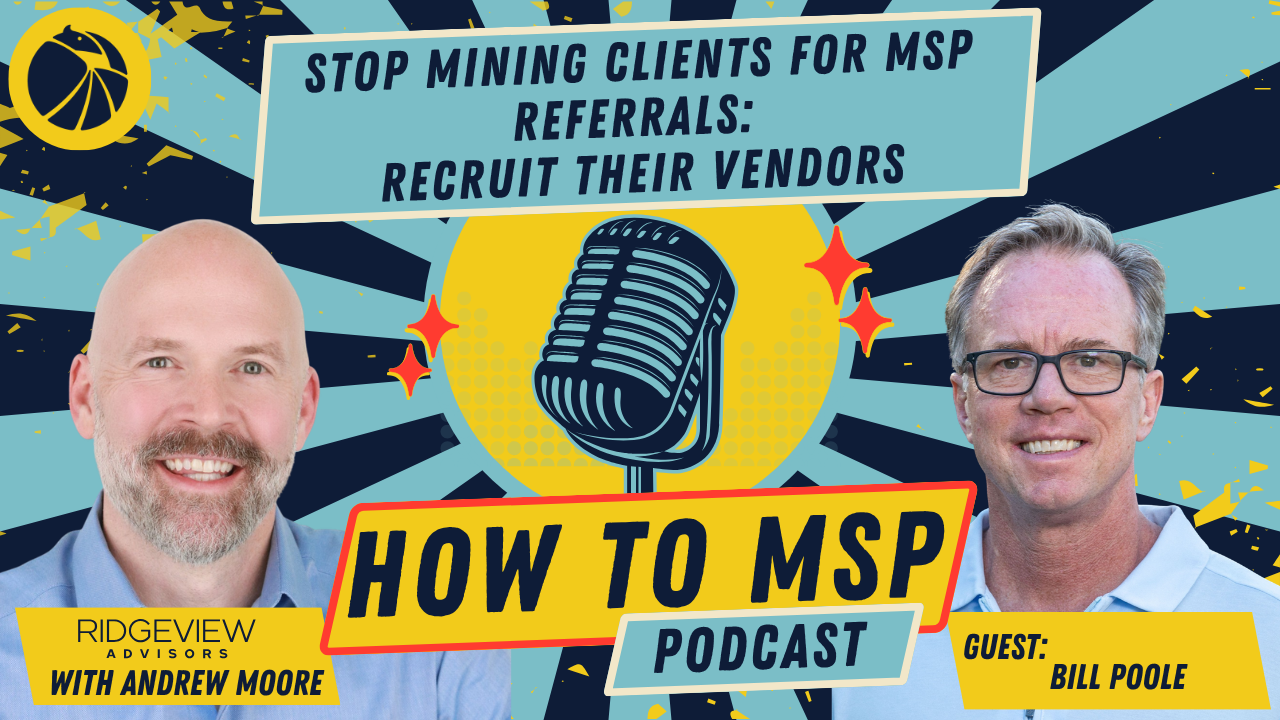
Stop Mining Clients for MSP Referrals: Recruit Their Vendors
Most MSPs run out of referrals because they ask happy clients. Bill Poole explains why the vendors already sitting in those clients' offices are the better source.
Watch
Listen
Subscribe on How to MSP© Podcast.
Your best referral sources are not your happy clients. They are the other vendors already sitting in those clients’ offices. That is the argument Bill Poole, founder of Convergo in Denver and creator of the Strategic Connector System, makes on this episode of How to MSP.
Most MSP owners build their first few million in revenue on relationships, then the well runs dry, the owner panics, and the reflex is to hire a marketing agency or drop a business development rep into the market with a quota. Poole spent two decades in B2B sales before concluding that the fastest-growing relationship-driven professionals were doing less networking, not more. Here is how an MSP builds that network, who belongs in it, and what to measure.
Business development doesn’t need to suck.
- Bill Poole, 4:06
What you’ll take away
- Your clients are the map, not the network. Ask them which vendors they trust, then go recruit those vendors.
- Do the math before you network. Most MSPs need only a handful of strategic connectors to hit their revenue goal.
- Ideal client clarity comes first. A generalist MSP cannot tell a partner what a good referral looks like.
- Referrals received is a lagging metric. Track referrals given and relationship deposits instead.
- Fewer, deeper relationships beat a wide network. Poole’s own connector group is a small circle that has met weekly for three years.
- Help first, ask later. Referrals show up as a byproduct of value exchange, not as a monthly request.
Why do MSPs run out of referrals?
MSPs run out of referrals because they never built a referral system in the first place. They accumulated relationships passively while delivering good work, and passive accumulation has a ceiling.
Poole frames it simply. There are three ways to grow a business: invest in marketing, run direct sales outreach, or manage relationships to generate referrals. The first two have been systematized to the point of tedium. The third, the one most MSPs actually grew on, is almost never systematized at all. It runs on the owner’s memory and goodwill until the owner gets busy delivering service, and then it quietly stops running.
The referrals did not stop because the market changed. They stopped because nobody was tending the relationships that produced them, and because those relationships were the wrong ones to begin with. For a seller-doer splitting the week between delivering service and developing business, efficiency is the whole game. If you only have a quarter of your time to sell, targeting end clients one at a time wastes it.
Who should an MSP ask for referrals instead of clients?
Ask the other vendors who already serve your ideal client. The fractional CFO, the PEO or outsourced HR rep, the commercial insurance broker, the business banker, and the ERP partner are all sitting in the offices you want to be in, and they are already talking to your buyer.
Poole calls these people strategic connectors. Wealth management calls the same role a center of influence, and networking groups call it a power partner. The label matters less than the test: a strategic connector serves the same ideal client, does not compete with you, and holds enough trust to sway a buying decision.
A happy client refers you once or twice a year, if they happen to hear a friend complain about their IT. A well-chosen connector sits in front of a dozen companies matching your profile every month. One is luck. The other is coverage.
Andrew offers the negative example from his own operating years. He spent time with an ERP rep who sold into large enterprise accounts, well above the size his MSP could serve, and it never produced anything beyond an occasional lunch. The local Insperity rep was a different story: same SMB segment, same high-growth targets, same premium positioning. The messaging lined up, so the introductions landed.
Clients still matter here, as intelligence rather than as the network. Take the primary stakeholder at an account you already serve to lunch and ask two questions: who do you trust, and which vendors do you have genuinely high-trust relationships with? That is how you build the target list when you are starting from zero.
How many strategic connectors does an MSP actually need?
Fewer than most owners assume. Run the revenue math backward and the number is usually small enough to manage personally.
Start with the revenue you want to add through referrals, divide by the average annual value of a client that fits your profile, and you get the number of new clients required. A warm introduction from a trusted connector, what Poole calls a third-base referral, closes at a far higher rate than a cold or random one. Work that conversion backward and the number of connectors needed to hit the goal is typically a handful, not a hundred.
Typically what people find is they don’t need that many strategic connectors in order to meet their revenue goals.
- Bill Poole, 4:32
That math only works if you know who you are selling to, which is why the conversation keeps returning to the ideal client profile, the specific definition of the company you are built to serve.
It all starts with ideal client clarity.
- Bill Poole, 8:02
Poole describes a spectrum. At one end sits the MSP who works with anyone that has a pulse. At the other sits the firm serving personal injury practices with three to ten attorneys. The specific firm can tell a banker exactly who to think of. The generalist cannot, so the banker thinks of nobody. Andrew adds a related warning. MSPs undercut themselves here, saying they want a seven thousand dollar per month client but would take a three thousand dollar one. That hedge travels straight to your partners, and they will bring you the smaller deal every time, because that is what you told them you would accept.
How do you build a referral network from scratch?
Build it inside out, starting from the clients you already serve, then define the profile of the partner you want before you go looking for names.
- Pick the segment you want more of, based on the accounts already profitable for you.
- Take the primary stakeholders at those accounts to lunch and ask who they trust.
- Write an ideal strategic connector profile, the partner equivalent of an ICP: role, industry served, client size, positioning.
- Meet several candidates in each role rather than committing to the first one who calls back.
- Score them in your CRM as you would score leads: shared ICP, value alignment, and whether they give as well as take.
- Narrow to a small group and invest deeply instead of maintaining a long list of shallow contacts.
Poole is direct about the qualities that matter. The connector has to be talking to companies inside your ideal client definition, you have to genuinely like them and share values, and they have to be a giver. Good connectors are usually business owners who are not going anywhere, which makes those relationships more durable than client relationships.
The engine is what he calls the help-first value exchange. Instead of calling once a quarter to ask for names, you create value in between: co-hosting an event, collaborating on content, introducing a candidate to a partner who is hiring, or connecting someone with help on an EOS rock. Poole runs a group of non-competing providers in Denver who all serve the same ideal client.
We meet once a week in Zoom. We’ve been doing this for three years.
- Bill Poole, 19:13
He has introduced three people to members of that group who ended up hiring them. None of those introductions were referrals in the revenue sense, and all of them were deposits.
What should MSPs track instead of referrals received?
Track referrals given and relationship deposits made. The count of referrals you received is a lagging metric, and by the time you are looking at it there is nothing left to influence.
If you’re tracking [how many referrals you got], then the ship has sailed on you. You’re not affecting anything.
- Bill Poole, 27:32
Andrew describes the scorecard he sees most often: new deals closed this month. When the number is zero, the plan is to try harder. His fix is to walk backward through the funnel, from close rate to contracts written to discovery calls booked, until you land on a weekly activity someone can control. This is the same discipline behind fixing a leaking sales funnel. Poole pushes it one step further and argues the discovery call is lagging too. Something produced that call, and that something is the activity worth managing.
His two leading metrics come from an idea borrowed from Stephen Covey: the emotional bank account. You cannot make a withdrawal from an account you never funded. Deposits are the deliberate acts of value you make with a specific connector, and they are countable. A workable connector scorecard tracks referrals and introductions given by connector, deposits made per connector per quarter, a connector score in the CRM scored the same way you would score a lead, and collaborative activities completed such as joint events or co-marketing. The scoring tells you where to stop investing. If a connector consistently takes and never gives, the scoreboard makes that visible and you move your time to someone who reciprocates.
Should an MSP invest in marketing or fix referrals first?
Fix the referral engine first. Marketing and outbound both work, but for an MSP with no existing marketing muscle they are the slower and more expensive routes to the same pipeline.
Poole admits he has made this mistake himself as a fractional sales leader. A prospect says relationships got them here but they need more, the instinct is to reach for something predictable, so you build a direct outreach program. The problem is that you just walked away from the motion that worked and replaced it with one the company has never run. He relays a line from a fractional CMO who said he wants to be a company’s third marketing agency, because the first two usually get fired before the work compounds. That is the timeline an owner signs up for when they treat an agency as the fastest fix for a referral problem.
Don’t throw the baby out with the bathwater when it comes to what got you here.
- Bill Poole, 25:50
None of this is an argument against marketing. If your growth targets are aggressive enough, you will need it. The argument is about sequence. When you meet a connector with a genuinely shared ideal client, results can arrive in weeks. Marketing spend rarely does.
The same discipline applies to tactics. Andrew’s standard first move for a client is a co-hosted lunch and learn: gather the PEO rep, the banker, the insurance broker, and the data center rep, ask each to bring three of their best accounts, cover the first bill yourself, and run a roundtable on cybersecurity without pitching. Poole endorses the play with one modification. Do not let it be a one-off. He cites Jennifer Zick, who trademarked the phrase random acts of marketing, and says the difference between a good idea and a system is whether it is on the calendar twice a year with last time’s notes in hand. The format has to fit the audience. A lunch and learn works for professional services. General contractors are on job sites. Design the event around who you are trying to reach, then do not overextend your time or budget on something you cannot repeat. If events are part of your growth plan, the same rigor applies to how you sponsor conferences.
Mentioned in this episode
Books:
Music:
Partners and resources:
Also referenced: the Strategic Connector System (SCS), Convergo’s Referral System Self-Assessment (a five to seven minute diagnostic Bill mentions on the episode), Stephen Covey’s emotional bank account concept, Jennifer Zick and the trademarked phrase random acts of marketing, and Insperity, cited as an example of a strong SMB referral partner.
About the guest
Bill Poole is the founder of Convergo and creator of the Strategic Connector System, a methodology that helps business development professionals and seller-doers build intentional systems for relationship-driven growth. After two decades in B2B sales and sales leadership, he concluded that the best relationship-driven professionals grow through fewer, deeper partnerships rather than more networking, and that insight became the SCS. Today Convergo works with seller-doers, biz dev professionals, and BD teams across professional services, including a new collaboration bringing the SCS to MSPs through a partnership with Andrew Moore and the Empath platform. Connect with Bill on LinkedIn or follow Convergo.
Chapters & timestamps
- 0:00 Meet Bill Poole and the Convergo referral system
- 2:30 Why MSPs hit a referral ceiling
- 4:00 Do the math: fewer connectors than you think
- 6:30 Ideal client clarity comes first
- 12:30 Build your network inside out: ask who they trust
- 16:00 The strategic connector profile and keeping score
- 19:00 The help-first value exchange
- 23:30 Why marketing is the slow, expensive path
- 28:30 Leading metrics and the emotional bank account
- 34:00 Lunch and learns without random acts of marketing
- 44:30 Coaching a BDR to build a network
- 47:30 Closing five: books, bands, and broken suspenders
Transcript
The full transcript is on the page (crawlable for search), collapsed for readability.
Read the full transcript
Andrew Moore (0:01): All right, hello, my name is Andrew Moore and I am the host of the How to MSP podcast. And this week we are talking with Bill Poole. Hello, Bill.
Bill Poole (0:12): Andrew, so glad to be on your podcast. Thanks so much for having me.
Andrew Moore (0:17): Such gusto and enthusiasm. I love it. Bill is the founder and president of Convergo. why don't you tell us a little bit about Convergo, what you do there, what you guys are all about, why people should care about your opinions in the MSP space. Just quick heads up on what you're up to.
Bill Poole (0:39): For sure. so at Convergo, we are razor focused on helping seller doers, founder-led sales folks, business development professionals that rely on referrals for their livelihood. So typically those types of folks typically sell high trust decisions. And when they're looking to grow, typically, as you know, Andrew, there's only three ways to grow your business. You can invest in marketing, direct sales outreach, or Managing relationships to get referrals. the first two are incredibly, almost maybe annoyingly systematized, right? Very metric driven and very systematized. And I'm a systems guy, I say annoying, so no systems terribly annoying for me. but we we systematize the relationship management piece in order to to to help those folks get more referrals. so that's in a nutshell, that's what we do.
Andrew Moore (1:36): That's awesome. where do where where do we find you today? Where are you physically located?
Bill Poole (1:41): I am physically located in my office in Denver, Denver, Colorado, which is where I which is where I live. So I work from I travel a good bit. we're a small company, but we're remote. And so when I'm not traveling, I'm here in Denver, which makes me happy.
Andrew Moore (1:59): Nice. Are you like in Denver proper or are you like in a is it easy to tell people that you're in Denver? Are you like outside of Denver? Like where
Bill Poole (2:06): I'm in I'm in Denver proper, in the city of Denver. So northwest Denver is Highlands is the is the name of the neighborhood. It's mile and a half, two miles from from downtown, close enough, yet far enough. So it's west of town as well, which means we can make it out to the foothills pretty easily to mountain bike, hike, enjoy and close to the mountains and enjoy enjoy outdoor life. So yep. Yeah.
Andrew Moore (2:10): Nice.
Andrew Moore (2:32): That's awesome. That's awesome. So let's let's start off with kind of high level. You had talked about why people should care about what you do and what Convergo does. And so I I want to talk a little bit about the MSP space and selling trust and just the idea that building sales. from referrals seems to be, at least in in our industry, in the MSP industry, one of the most important things that folks are doing in order to grow their business, right? A lot of times they're not coming into the MSP space with a significant amount of sales experience where they're like, well, I'm gonna go out and I'm gonna, you know, install Salesforce and I'm gonna build out all these KPIs and I'm gonna throw three or four hunters out there and we're gonna go do this thing and I'm gonna build my company that way. A lot of the times they they build their company because they've they've done a good job. And what I hear a lot is, well, we've done this really good job of working on our referrals. And then they get to a certain point where they're like, well, I I ran out of referrals. Right. And so like talk to me a little bit about like
Bill Poole (3:32): Right.
Andrew Moore (3:37): What is what the the program that you have that you work with companies on? Like talk to me a little bit about your idea of like just the fundamental. Let's just start at the very beginning. Like, what are we doing? How how why are we not why are we running out of referrals? Like what is the important part of like building a referral network? Like talk about the fundamentals of it first and kind of give everybody a background on like what you mean by building a systematized referral network, which is like fancy words for what? Like what does that mean for an MSP owner?
Bill Poole (4:06): Okay, well business development doesn't need to suck. And I know that a lot of folks that are really good at delivering value in the MSP space probably thinks business development sucks, right? and it's like, you know, relative to chewing on tinfoil, business development chewing on tinfoil, probably similar similar activities for for an MSP. but what it what it looks like like
Andrew Moore (4:17): Mm-hmm.
Bill Poole (4:32): It's talk about how to get there later. But what it might look like to do business development is you do business development on your terms. You get with people that are going to be the best people that are gonna introduce you to potentially other strategic connectors and people that are that need your services. So you sp you need to when you do the math. It's pretty simple. Like if you look if you count up the amount of if you do math on a napkin and you you look at how much revenue do you want to generate through referrals and you do the math, you don't typically what people find is they don't need that many clients to meet their revenue goals. And if you think about like a really warm referral from a trusted connector, like a third base referral, like those are the ones that close. A high percentage of the time as opposed to someone that's a relatively random referral, you get a bad referral. Someone really knows you, they give you a, you know, they give you good referral, you have a high percentage chance of closing it. If you do the math, you typically what people find is they don't need that many strategic connectors in order to meet their revenue goals. So I wasted a lot of time, Andrew, doing business development the wrong way. Like targeting, you know, if you're delivering services and trying develop business at the same time you need to be very efficient so targeting you know targeting the end client can isn't the best play a lot of times unless you've got all day to develop all day to develop business so if you do the math you only need to need typically a few strategic connectors therefore you should be very selective about the strategic connectors that you engage with so you're managing fewer deeper relationships then
Andrew Moore (6:19): So go ahead. No, sorry, yeah, I was gonna say so I wanna make sure that I'm fully caught up on the concepts here. so you talk about the strategic connectors, you talk about you know the number of clients that you need to hit your revenue goals. Sometimes our MSP owners and or sales executives in the MSP space may not be as sophisticated.
Bill Poole (6:20): Go ahead, Andrew. No, you're first.
Andrew Moore (6:46): in building out a firm sales environment, right? People who don't come out of like a professional sales system. So we talk about that, like I think I want to make sure that people understand if you want to hit a certain amount of money every year for your revenue goals, I to Bill's point, I think it's really important that you sit down and say, well, what is my target, like what is my ICP, right? My ideal client profile. Like what is the target size company that I want to work with? And I think a lot of times MSPs will potentially actually cut themselves a little short by saying, well, you know, I'm really looking like for a five or a $7,000 a month client, but I mean I'd be happy if I got one that was three. And I think that does them kind of a disservice when it comes to trying to grow their business and then building a referral network because you really want to be clear with these these partners that you're talking to that you want to build these referral opportunities with. You want to be clear about what it is that you're looking for, right? Like what type of client you really want, because you want them to be referring you the right types of clients just like you want to refer them the right types of clients. Is am I off about that or is that kind of a fundamental aspect of making sure that we're all clear about what we're trying to accomplish with generating revenue through referrals?
Bill Poole (8:02): 100% it all starts with ideal client clarity, right? And I had this discussion. We had a workshop yesterday and one of the folks in my workshop is you know he's an operator, he's a fractional fractional integrator. And you know, he's starting his journey in in the fract being your fractional integrated and you know he's worried about developing his network. So let's look at two ends of the spectrum. On one end of the spectrum, zero clarity on who your ideal client profile is. Okay, and I I work with anyone, like you just said, right? I work with anyone that has a pulse. On the other end, it's like I work with personal injury lawyers that have, you know, between five and or or like you know, three and ten l lawyers, you know, very, very, very specific ideal client profile. So if you think about it, if you're trying to develop a network of strategic connectors or referral partners. It's kind of it's which one's gonna are you gonna who's gonna have an easier time? The person's a generalist or someone that's very specific?
Andrew Moore (9:07): Right, right. And I and I think that that's super helpful because it would just be like any company coming to you and they'd say, like, Well, you know, why don't you give us some referrals? And you'd be like, What kind of referral like I I know plenty of companies, like, what kind of referral do you want? And they're like, Well, I don't know, like we'd be willing to talk to anybody. Well, that doesn't help me as a referral partner, right? I don't know how to help you get their like I think it's really important that MSPs at least do a little bit of homework and understanding who they're trying to sell to, to your point, what revenue targets they want to hit, and not to sell themselves short. Because I would guess that, you know, you as an MSP are in wanting to grow your business, you're gonna not want to waste your time with type with the types of clients that aren't gonna be a good fit for you long term, right? And you wanna make sure that you're gonna, if you're gonna spend this sort of concerted effort, which I'm I'm sure you're we're gonna get into here in a second, is This is relentless. Like this is one of those things that we have to be constantly outdoing and nurturing and evolving. And building one of these networks, I think, is it takes time, right? Like, can we talk a little bit about that? Like, you know, as you've kind of established what these networks look like, how do you build one? Like how much time does it take? Like, what does an MSP need to do to start getting out there and like creating some sort of like system where they're bringing in referrals?
Bill Poole (10:30): Okay, so if the the MSP that does not have an does not put a stake in the ground and have an ideal client focus, how do they develop their their network? I don't know, people that are I'm gonna look for influential people in wherever, all right? Well you don't know like what are you doing? Like someone that's connected with a lot of people on LinkedIn is someone that I wanna be with. Well
Andrew Moore (10:48): Right.
Bill Poole (10:54): That they may have a big audience, but are they talking with the right people? Are they people that would actually end up referring you? Right. Alternatively, on the other end of the spectrum, you've got an MSP that focuses on, let's keep it keep it legal here on the law firm side. If I'm an MSP that focuses on serving law firms, then you know, who are the people that I'm talking to in law firms that are making the decisions for me? And who else is providing value? in those law firms for that person that is talking with that person all the time. It's a lot easier to build a really good network of referral partners if you're looking for people whose services are going to complement yours, that are going to be actually the if ideally if their services are improved if you do a good job, then that person is is looking for refer for business for you for themselves at the same time. Right. So building a network, if you do have that clarity on who your ideal client is, it's a lot easier to build a referral network.
Andrew Moore (11:49): Right.
Andrew Moore (11:58): And so like let's just say that I'm an MSP and I'm a generalist MSP. Like I just have a lot of a lot of different types of clients, but let's just say that, you know what though, I do really want to focus like on professional services. Like I like accounting firms, I like law firms, like they they're pretty lucrative for me. I have half a dozen of them in my portfolio that I'm supporting currently. How do you suggest that a company like an MSP go about the process of developing a list of potential referral partners, right? Do they go directly to these clients and say, who are you working with? Or do they look in their own Rolodex and say, who have we run across at these clients in the past or who do we want to be working with? Like, where do you really start to unravel this? Like how do you start the process to to identify who you want to work with?
Bill Poole (12:48): Great question, Andrew. So if you are serving those professional services businesses, I mean, who's the primary stakeholder there, right? So take them to lunch, ask them some questions. Who do you provide value? Who do you trust? like the who who do you have extreme what vendors do you have extremely high trust relationships with? So that's kind of like going inside, you know, inside out, which you know, if you're starting off which works if you're starting off with zero. You know, if you you you may be starting off without any network at all. You can get up to speed pretty quickly if you if you do it that way. So just ask questions. Ask questions if you've got if you're not yet serving that that space. I'm sure you have friends in the professional services space. Ask questions about you know how they make decisions, what vendors do they, you know, what are really high trust vendors. And then you can actually kind of work on developing your referral network as you might in the same way that you might develop your your client book a business, right? Except that referral network can be more valuable even than. your than your client network as well. So ask questions, find out who they trust. And those are the people, you know, if they trust a business broker or whatever that whatever that person would be, in professional services, they might have a maybe a business coach or something, which is not very specific. but you find out who they trust and build your network kind of inside out.
Andrew Moore (14:16): Yeah, that's that's great advice because I think a lot of folks don't really know how to start eating the elephant. So they're just like, man, it seems like really hard. Like I don't even know where to start. And I think it's important because most of the successful MSPs I I know, they just go out and and talk to people. Right. They're just out there having conversations and trying to get a better understanding of what the market needs or who in their network could use their services. And those kind of relationships develop and then they, you know, begin to branch out and then they grow and they grow and they grow. But I see them constantly nurturing those networks. but I also see those networks growing and changing over time with the ones that stay successful. and I never thought about the systematic processes that you were talking about in order to maintain those networks. But what I'd like to to understand more about is What is your advice for someone who's like, okay, great, like I've decided I'm gonna go out and I've met like five different companies that I wanna people in different companies that are adjacent to my clients, like I've started this process. Like what qualities do you want to see in those people? you know, what do you want to see from them on a regular basis? Like how does the actual system work where you're like out trying to build the networking, actually getting referrals? Cause I'll be honest with you, there have been times where I've worked with the local, you know, internet provider rep or I've worked with the local low vault guy. And I'll be honest with you, like, he never really brought me deals, but I was always bringing them deals. And that was frustrating. Right. And it got to the point where I was like, you know, it wasn't selfish, but I was also like, I'm bringing you a lot of business and I don't really get any referrals in return. And so I felt like maybe I could find a better fit, but I got lazy and I didn't want to do it. And I was just like, well, that just seems hard. So as long as my clients are taken care of, I guess I'll just sit here and not get referrals. Like can you talk a little bit about that process?
Bill Poole (16:11): Sure. I mean one thing is just keep score. I mean, if you've got what you feel like are you've got a it's really it starts with an ideal strategic connector profile. Like what is the type of person and that sounds in you know it's best to separate the the names of people from your network. Like what is the best person first for that's gonna be a really good referral partner for you? Right. And that that's like You don't know if they're gonna be a if you're gonna like but you can look at a database and know that this person is probably talking to the people inside of my ideal client businesses that is going to be able to help me. so that there's that component and then s and then whittling it down, say that there's a you know say that a a a CFO is a is a you know, a CFO is a good good contact. You meet five CFOs, then you wanna You wanna you know ideally my my system is really about prioritizing the best few connectors that you have. So in addition to being connected, like there's a relationship piece there where you like them, right? You have value alignment and things like that. And then they are a giver. Like you don't want to be continuously giving, you want it to be a mutual a a back and forth thing. So we keep score. I mean in the CRM, like we have HubSpot and we help our clients with HubSpot where we've got a a dashboard and HubSpot has lead scoring for for leads for clients. We do we do scoring for our strategic connectors as well and we have a scoreboard. So you can if they're not referring and if they're not if you're not getting referrals from these folks then you then you don't invest time in them. And you invest time in the folks that are.
Andrew Moore (17:40): Yeah. Well, and and I think it was interesting that you brought up, are they selling into or working with companies that you want to work with? I've in the past made the mistake of working with like a like an ERP vendor, right? The the that ERP vendor was selling into very large accounts. And there was not an opportunity for us when we were that size in a MSP to sell into those accounts. So it really just became like
Bill Poole (18:04): Is it?
Andrew Moore (18:13): an opportunity to go to lunch with somebody every now and again. Like we never really wound up having a a a relationship where we were helping each other. But the the thing that I found very rewarding was like the local insparity rep. That person was selling directly into the SMB space that we were selling into and we knew all the same companies. and so we really tried to get together and make each other look good. And that was a very fruitful relationship, right? Because we were selling to the same type of client. And to your point, we were very much aligned on we were a more premium package, just like Insparity was, like we wanted to work with high growth companies like Insperity did. Like there was a lot of things that I think from a value perspective, like we were both moving in the same direction with the same types of clients. So our messaging landed properly. so I think it's really important what you said and that it's more than just are they bringing me leads? But it's also some of these other ancillary things that I never thought about until you just said it. I'm like, ding ding ding. Like that seems like it's something that would be really helpful to know.
Bill Poole (19:13): Yeah, for sure. And I mean there's other ways to help also besides besides the besides the lead thing and get the refer and referrals. Referrals really come second in my system. If you think about finding people that are help first, that that are going to be good referral partners that do indeed that do indeed help first, what are you gonna do with them to provide value? Is it is it just golfing or or lunch? That that's good and you have rich conversations. Or you can collaborate on things like this. Andrew, thanks for inviting me to your podcast, like collaborate on marketing events or podcasts or things like that. something that that we call that the help first value exchange, right? So instead of getting on the phone once a month or once a quarter and asking for referrals, what are you gonna do to exchange value in the meantime? I've got a group that I created, which is part of my system of of non-competing providers. In the Denver market, we all serve the same ideal client. We meet once a week. that sounds like a lot in Zoom, right? We meet once a week in Zoom. We've been doing this for three years. We really like each other. Like there's different ways that we help each other. It's not about getting referrals. I think that I've referred three different people. I I've referred people that have been hired into the into people in that group are looking to hire people. I've I've given three different connected them with three different people that they've end up hiring. Right? What are your what are your and we're very EOS-y, what are your rocks? Okay, well I've got someone to introduce you to to help you with the rocks. And then guess what happens when you take that approach? Referrals are a byproduct of that and they just come naturally and it's not just like a transactional referral. It's really about being more intentional about like a really a help-first approach with the right strategic connectors that also give back.
Andrew Moore (21:06): Well, and I I kind of we had a a bit of a an idea of how we wanted to touch on things today and I got a little out of order because I got right into like how how do you do it. but I think this kind of goes back to something that I wanted to touch on that I I skipped over, but there's so many tools that people get sold, in a lot of ways, where from a sales perspective They are constantly being told, well, if you just get out there and you you, you know, optimize your website and you, you know, put enough YouTube content out there, or if you're, you know, doing enough you know, cold email blasts, or you're doing this or you're doing that. And I I wanna make sure that I'm clear about a lot of those things are important. Like they they they happen to to support the marketing efforts that you're putting forward to create legitimacy around your business and your brand. But I'm So grateful for the fact that you brought up being out there and just networking with people and having conversations and being intentional about giving to the other businesses that are trying to grow in your community or in your channel or whatever. Like to me, that's the gold. And I think that so many MSPs or even small business owners don't take the time to do that because they're just busy. Right. And they're like and they're not they're like, man, that just seems like it's me getting together and bullshitting with some people and like. But I mean, let's talk about that a minute. Like, talk to me a little bit more about the transformation you've seen in some other businesses. Like, how does this really work? Like, are you seeing it like all the time? Like if is it what you put in is what you get out? Like, like really like give everybody the secret sauce part of it. Like is it is it working? Like how do you how do you see it?
Bill Poole (22:46): So I mean I I is i is like the the referral approach working? Is that the question?
Andrew Moore (22:51): Yeah, like the effort the effort against the the the outcome, right? Like is that what you're seeing is like if you if anybody puts in the time to do the networking and the and the integration into a group and to take the time to get out there and talk to other business owners and really understand their network, i are they gonna see good things out of it or do they have to have a specific agenda or do they have to be very intentional? Like w at at what level does the commitment to being a part of something, right? Help generate an outcome and then layer that on top of like a process and a system. Like let's just talk about that a little bit.
Bill Poole (23:29): So I'm I'm gonna I'll tell the beginning of a story and validate if what I think is right. Think about your the the MSP grows on relationships and referrals, has a bunch of happy clients and realizes the referrals have dried up. You said in the beginning, right? What they would typically do is okay, our our we've got aggressive goals and we need to do something differently. So what what they do typically is invest in marketing or direct sales outreach.
Andrew Moore (23:43): Right.
Bill Poole (23:58): Well, and and I'm guilty of doing this myself as well, but marketing how marketing if you've not done a lot of marketing, I know a lot of MSPs probably haven't done as much marketing as they should. Market if you're gonna do pure marketing and expect that to bring you leads That is very expensive and takes a very, very, very long time to get traction, right? And I've as a fractional sales and revenue professional, I've made mistakes. when when clients came to me or prospects came to me and said, you know what, I've grown on relationships and referrals, but I need more. So okay, well, you want something predictable and systematizable. Let's go to direct sales outreach then. Well, that's not really a That's doesn't make that's not what's worked to date. You can get better at getting referrals. If you need to s you know, spin up a a direct sales outreach program, that takes a lot of time. So like Just shifting to a bit more intentionality with how you're managing the right relationships to get referrals is I mean, that is I mean you can get traction on that pretty quick. I mean, you you you think about times when you really connect with a you make a really good connection with someone that you can tell is gonna be a great connector. You know, if you've really honed in, you got common ideal clients, you guys are talking the same talk right off the bat, and they're gonna they're talking. With your people, you're gonna get results really, really quickly, a lot quicker in that than investing a lot of time and money in marketing. And when you invest in marketing, you know, I've got a I was talking with a CMO this morning, a fractional CMO organization. He says, Bill, I want to be their third, I want to be their third marketing agency because typically they fire the first two before because they've been really, really, you know, really challenged. And that you know, that's the that's the truth. So it's gonna take a long time to get results the other ways. You might need to if you're
Bill Poole (25:50): goals are really really really aggressive you're gonna need to do something and invest in marketing and or direct sales outreach but don't throw the baby out with the bathwater when it comes to what got you here.
Andrew Moore (26:02): Yeah, that that's exactly what I wanted you to talk about. 'Cause I think people feel like y I I always kinda take this approach at like all you know All streams lead to rivers, all rivers lead to, you know, the ocean. And, you know, as long as you're on a path. Like I my recommend, you know, whether it's going to the gym or you know, doing doing this networking thing, it's like just get out there. Like, even if all you're doing is just starting the process of going out to figure out who you want to talk to, start flexing the muscle of I showed up to a networking breakfast. Yeah, and it was kind of weird and I didn't like all the people there. And so maybe I'll go back the next week and see if it's any better. Or go to your local, like, go to a conference, like in your industry. industry, right? And just sit at a table full of a bunch of people at lunch that you don't know and have a conversation. Like, like I I feel like there's so many good things that come from just raw networking and being out having conversations that people don't do it enough. And I think that post COVID, I've I believe that everybody's started to really understand how important it is to be in person and and shake hands and have conversations. not that this medium of being able to meet each other virtually and you and I have not met in person. I think that's fantastic. but I I can tell you that my time spent at the PAX8 conference last week was fantastic. Like I met 10 or 12 new people and I've talked to two new partner opportunities for vendor relationships and like all these things that happen just by being around, right? Being in person.
Bill Poole (27:13): Mm.
Bill Poole (27:32): Yeah, and you mentioned like go going to that breakfast that was terrible. Actually if they're th you're thinking that was not really a good use of my time. But you you do have to get out there, but you do need to do so with intention and really figure out what breakfasts you're gonna go to and what is the best planned. It can't I mean it can be random, but you're not gonna get grandm great results being random. You need to do you need to kind of pick your po you don't have it's not like you've got all kinds of 100% of your day to invest in in marketing, I mean in business development, you need to make the best use of that time as possible. So you need to figure out where your time, energy, and money is going to get the best bang for your buck and keep score. Like keep score, you keep your your own scorecard. I mean the the typically what I see MSPs and otherwise is the the the metric that people typically track when it comes to referrals is how many referrals did you get? If you're tracking that, then the ship has sailed on you, you're not affecting anything. Like you need to have that's a lagging metric. Right? So what is it that you're gonna do and what is it what are the activities that you need to track and keep score of that's gonna result in getting referrals. So it's really it can't be random. You gotta be intentional about it. And it's not that hard. It's a lot simpler than when you have a plan, you know what you're doing and you keep score.
Andrew Moore (28:53): So that's a really, really I wanna dig into that. I want I wanna dig into that with you because when I work with my clients, one of the first things they come back to me with their scorecard is they're like, you know, number of new deals closed this month. I'm like, Cool. Like, I love that for you. Right. And let me ask you, like, so if it's zero, what w what are you gonna do? And they're like, Well, we're just gonna try harder. I'm like, well, maybe let's test like to your point, let's go back three steps. If you know you're at a thirty to fifty percent close rate, right, on writing contracts, and you know that if you write at least four contracts a month, right, that you're gonna you're gonna wind up closing at least one of them, let's just say. And then if we back up from that, you need to have six discovery calls in order to get to four contracts. Maybe we should say that we need to have at least two discovery calls a week. Like let's start there. Right. Like the let's back up to that. And then that way if you didn't hit your two discovery calls, you know next week we may may need three or four. And then you can actually affect some change with your forecasting rather than just being like, didn't hit it again. Right. So
Bill Poole (29:59): Yeah. I mean the you keep score of ha the deals that you got, that's in QuickBooks, right? You don't need to put that on your salescore card. That's that's already done. And arguably, Andrew, I'd say that the discovery call thing
Andrew Moore (30:05): R right.
Bill Poole (30:11): I think that's a lagging metric, quite frankly. What do you what what's gonna lead to a discovery call? It's gonna be that activity with those strategic connectors or referral partners, or that, you know, the amount of your website traffic, right? Or like the amount of blogs that you write. Like so the the amount of discovery calls, that's almost too late, also. So you want you need the discovery calls that are gonna get to the business, but you you know, if you want to be really metric driven and and disciplined, then what is it, what do you do, what do you need to do that's gonna get
Andrew Moore (30:14): Okay.
Bill Poole (30:41): To the discovery calls, whether it be direct sales outreach, marketing, or managing relationships, there's a there's a further leading metric there.
Andrew Moore (30:50): Well talk talk talk to then 'cause I want to dig into that leading metric on referrals. So you said there is something that you want to see tracked beyond just did I get a referral or not? Like what what do you see? Like what's the magic unlock? Like what what do people need to be doing that need be tracking to hold themselves and their sales team accountable to getting that referral? Like what does that look like?
Bill Poole (31:09): Okay. So one thing is the amount of referrals that you give. That's one thing. So if I if I give a hundred referrals and someone gives zero referrals, like who's gonna get more business coming back, right? So it's it's really like that's something that I do have control over is the somewhat, right? The amount of referrals that I give or the amount of Introductions that I make. There's a Stephen Covey concept, Andrew, called the emotional bank account. And the emotional bank account is about making you make deposits, right? If you like a bank, if I open up a bank account without making a deposit and I go try to make a withdrawal, they're gonna look at you like you're crazy, right? But you gotta so you put money in the bank and you can take money out. The emotional bank account, the covey concept is you make deposits, emotional deposits. Like how I have my strategic connector group, you can keep score in your in your CRM how many deposits.
Andrew Moore (31:37): Mm-hmm.
Bill Poole (32:01): have I made to my strategic connectors, not just random people, but if I have my list of ten, I should be making a deposit you know Once a month or once a quarter, whatever whatever the right number is for the amount of people that you're managing a relationship with, make those deposits. And those deposits, that's why it's really that's why my system is really about having fewer, deeper relationships. And those deposits can be more significant. It might be a a recommendation for for someone that's gonna hire an employee. Or it might, you know, it's it can be a really rich deposit as opposed to Or you know, introducing someone to a strategic connect someone that's may turn into a strategic connector themselves, right? So measuring the things that that are gonna get you out of they're going to end up in referrals. the two big ones that we have are re f giving of referrals and then those emotional deposits.
Andrew Moore (32:55): That's really excellent. Like I think to your point, like if we can't give a hard referral, just giving a some good advice or giving somebody another person to talk to really can be can be very helpful. Especially like it I I always say that hiring is a lot like sales. It it you know, you gotta strike when the iron's hot, time kills all deals, you gotta market yourself the right way, on top of making sure that that person's a a a good fit. And if I'll I'll take a referral to hire somebody any day off of somebody cool from the street, right? So like referrals for me when it comes to hiring are just as gold as getting a client, 'cause sometimes an employee will be with us for I've had employees with me for eleven, twelve years, right? Or longer. You get the right person.
Bill Poole (33:28): Yeah.
Bill Poole (33:37): Yeah. For sure. And it that applies to those strategic connectors as well. I mean, the strategic connectors that I have are owners of businesses that aren't going anywhere. My clients, you know, the clients turn over to an extent, right? But you know, you're if you pick the right strategic connectors, the ones that you know that are in it for the long haul, then those those folks can be really, really valuable as an employee can be as well.
Andrew Moore (34:02): Well, and so one of the things that I, you know, just to kind of talk a little bit just like tactically, because we've been, you know, kind of at a at a higher level a little bit, but the ad and tell me if I'm wrong here, because you already shed light on a couple of things that I want to talk to my clients about that I might change, right? Which is great. So when I talk about and I never looked at it the way that you did, right? It was just something that we used to do that was helpful and I never systematized it. But I give this advice to my clients. They're like, how do I go get more business? I'm gonna go spend a bunch of money on a marketing company and I'm gonna buy HubSpot. And I'm like, cool. I was like, before you do that, my recommendation is that you go find Like if you have a a local HR, like an outsourced HR company like Insparity or a PEO or somebody that you have worked with or works with your clients, go talk to their local rep. go talk to your local internet provider, like the one that you like that provides great internet, like somebody that is a rep at the one of your local data centers. Go talk to somebody that sells business insurance because of IT security. Go talk to a local bank or credit union, right? That does business to business type loans and stuff, right? And get them. them all together or talk to them individually and talk to about putting together a lunch and learn about something that's important. Something super easy like cybersecurity. Like say we're gonna do a lunch and learn. I'm have all of you bring three of your your favorite accounts. Right. And we're all going to bring them all together. And, you know, I'll say the MSP for the first first one. I'll say that I'll foot the bill for the first one. Right. I'll pay for the food. I'll get the event booked. I'll show up. Everybody can brand it. Right. We can cross market it. And we're all going to get up and we're not going to sell. We're just going to have a round table about the importance of security in your business when it comes to employees, when it comes to the banking, your finance, like your IT, all that stuff. And at the end, if they want to work with us, then we'll be around. And I'm like, start there.
Andrew Moore (35:55): That's my advice. Like, but after that, I don't really have any advice after that. Like, that's my first bit of advice is like, do that and see if it works and then get back to me. A lot of my clients have done that and they're like, well, this is great. We're gonna do more of these. Some of them just never get around to doing them. Am I wrong in saying that that's the approach? Or is there a better way to do this? Like instead of jumping straight to an event, like What what do you tell people? If if you saw me in a room tell my client that, would you be like, that's a great idea and I'd start there? Or you'd be like, Well, it's okay, but maybe I would do it differently. Give me some advice here. Like what what should we be telling people?
Bill Poole (36:28): think it really depends on who you target. Like you're you know, if you're targeting Contractors, right? What is it that they need? What would resonate with them? It it it it it's that ideal client clarity is so important. And what what what is gonna resonate with those people? what's gonna resonate with the professional services organization is gonna be different than what would resonate for like a builder or contractor, right? Are they gonna come to a lunch and learn? Are they on site, right? So it it kind of it's really dependent on who the target is. But if you think about if you're proper if you've picked a great connector and you know you think Think about your your great connector ideally serves the same audience. I would say that like with that formula that you just had, that you just said with having that lunch and learn is great, but don't make it random. The Jennifer Zick is someone I know that that she trademarked the random acts of marketing right random acts of marketing is doing like you know just a one-off thing right if that's a good idea make it a make it a thing like do it regularly two times a year make it a system so that you're not making decisions on what are we gonna do in the fall? Like well you got a system. Last fall we did this and we're gonna to make it better this time. So just the consistency behind is to really have a plan which is very dependent on who that ideal client is and don't over you know don't
Bill Poole (37:53): don't make the plan too aggressive. Don't overextend yourself financially or more importantly, like your time and energy. Make it a a plan that works given what you need to do, you know, outside of that. But the if you if you pick the right things and do them, you know, regularly and peel out the garbage that that that doesn't work, you know, that's the idea.
Andrew Moore (38:14): So so the the modification to this plan, which we come back to kind of full circle, we talked about at the beginning, is really focus on that ideal client profile, like If we're like, listen, we're gonna do this thing, but we're really excited about general contractors. We think that the construction industry is a really booming place right now. and we wanna get a bunch of them together and we wanna talk about the importance of IT security in regards to GCs. And so we're gonna, you know, if you guys have got clients that are between, you know, twenty five and a hundred and twenty five employees, bring Like, especially if they're GCs, right? Like we want to have that conversation because we're gonna gear it directly towards that from a messaging standpoint. standpoint. Does that that sound like a fair modification?
Bill Poole (38:55): Yeah, for sure. Yeah, I was it made made me think of a conversation I had with with a guy down down in in New Orleans and he was serving He was serving a b a guy a bunch of folks in the Maritimes, right? They're their their ship. I think they provided services for for ships and such, right? And he said that, you know, w and you can cut this if you want, Andrew, but what his what what his ideal clients like to do is they like to go to the girly bars, right? It's like, okay, we'll take like have an event at a girly bar then. Whatever, you know, it the the person matters.
Andrew Moore (39:32): Dude, I I'm from I'm from H Houston originally. Like like I think they invented strip clubs in Houston. Like that's an oil and gas like thing. So yeah, no, I get it. Yeah. I mean, James Harden played in Houston a really long time because of our strip clubs. So for sure. For sure. But yeah, I mean it's i if you know, know your audience, I think is a is the most important thing that you could say is that, you know, i if
Bill Poole (39:35): Okay.
Bill Poole (39:40): Yes, yeah. The professional service is I've heard about him.
Andrew Moore (39:58): You that's another thing that I think is a really important thing about, you know, if you're just gonna use the the idea of of doing a lunch and learn or whatever. But to your point, I was just talking with a a client recently and they were they had this really fantastic private room at the top of a building that they have control over in in downtown. And they would invite people to this room for events. But what it felt like when people got invited to this was they were being invited to a private room at their office, right? So they kind of expected to get sold, right? Whereas this last event, I was like, let's go ahead and have that at Vic and Anthony's. Let's have it at a steak place, right? Downtown, right? So that you're still, you know, central. But let's see what happens. And they had a fantastic turnout. Right. Like there were a lot of people that were like, like I know Vic and Anthony's. I know the quality of the food. I know what I'm getting. I know I'm gonna get sold a little bit, but I could always get up and leave if I wanted to. I can pretend I'm going to the bathroom. And so like I think Yeah, after the sake, right? Like as long as but like I think it's important that to your point is it like know who your audience is. Like they invited executives and
Bill Poole (40:56): Mm-hmm.
Bill Poole (41:00): After the stake.
Andrew Moore (41:09): high-level like, you know, sales associates and stuff like that to come out to this event. and so they had a good turnout and that was the kind of crowd you wanted there. And they had a really good networking time at the beginning where there was a lot of conversations and swapping of business cards. So I was really excited to hear that that turned out for them. But I think it was because they picked the right venue and they had the right mix of people, right, at that event. Yeah. so one of the things I do want to touch on before we we run out of time is
Bill Poole (41:31): That makes sense. Yeah.
Andrew Moore (41:39): This sounds like it's really good for MSP owners, maybe even some MSP executives. Can this translate to like if if one of my MSPs that I'm working with is got like a a like a lead salesperson, can they really master this sort of thing? Or do you have to be do you have to have more gravitas to get out there and build a network? Like talk to me about who the right fit is for this.
Bill Poole (42:03): No. We had we actually had two in a a recent workshop. I think it was the the April workshop. It's we did workshops that last about four weeks. We had a couple of cybersecurity reps, their business development reps in there that th that absol develop develop their own system. And it can be more effective if you think about it with it can if you have A what those folks have is budget a lot of times. They've got a marketing department potentially behind it. If you've got things a marketing department could support a business development rep to c who creates his or her own system, a lot of times those can be better events. And a business development rep. The guy, the the main rep that came through was having, you know, I think he just hosted the event last week in Chicago, with another a hardware provider that it was a mutually beneficial referring situation where you know they provide the hardware and like the the the the guys that came in the the guy that came through my workshop work for the cybersecurity company. They collaborated on a a workshop together and they're gonna do it you know, I think they do it once a quarter. So it absolutely I mean it w really it it's it's a little different for a founder that or a seller doer that's provided somebody's providing services that only has twenty five percent of their time. For someone that is is a pure biz dev person, they've got more time. you know, they got more time to invest in doing that and can really, you know, potentially extend extend the reach there. so I don't know what they would do otherwise if they you know if you get if they rely on referrals for their business, you know, it it put a plan in place and and make it not random.
Andrew Moore (43:40): Right.
Andrew Moore (43:43): No, that that's super helpful because I think the other side of that is, you know, if you've got a a a business development rep to your point, I always tell my my owners, I'm like, don't hire a salesperson unless you're ready to manage a salesperson. Right. And a lot of times I'm like, no, I'm just gonna hire the salesperson. They're gonna go sell stuff. That's what salespeople do. And I'm like, all right. I was like, I'll talk to you in six months. And And so when you when you decide that if you've got a a business development rep and if you are like managing them a little bit, I think w the last thing I want to find out from you is you talked a little bit about leading indicators, lagging indicators. What do you tell if you were to walk in cold and you and you brought in a a a BDR to an organization, what would you be telling them like, hey, this week at our one on one, like I need you out doing this to to start building this network or to maintain this network? Like, are you gonna be tracking like opportunities that they've had to give to others? Are you tracking like, you know, straight referrals? Are you tracking like you know, events that they're going to? Like what are you tracking to make sure that you're reinforcing that with a BDR rather than just holding yourself accountable as a as a lead salesperson?
Bill Poole (44:53): So first of all, there's in that example there's a lot of different ways to go and the people you can hire. You can hire a BDR that's a salesperson that's looking for a job that it which means they're there's no guarantee they're good at what they're doing because they don't necessarily have a job. They may not be connected. And so if they need to build a network, then that's a whole nother thing. Alternatively, you can hire the person that has the network, you're really hiring the network in some cases. So it's gonna be a little bit different. if you if you it's expensive to hire that person that already has the network, but their time to performance is gonna be drastically different than someone that is starting from square zero selling a high trust decision without a network. So what I would encourage if you did go that route. and hire the on the you know hire a bdr on the cheap that doesn't have a network I recommend that you that as an owner that you work with, not just tell the BDR what to do. here, do this, that, or the other. I would work on a plan with the BDR to help them to develop an ideal strategic connector, to set goals, to develop an ideal strategic connector profile. Then, based on you know the ideal clients, what are the activities that you're gonna do? So I would co-create, I you know the founder or the sales leader is going to lead that discussion, but just don't tell them what to do, co-create a Plan that starts with who the ideal client is, what the goals are, you know, therefore, how many relationships do you need? So, therefore, what's the right profile person and what are the activities that you're gonna do with them? And then how are you gonna measure and track it? So I would do I wouldn't tell them what to do, I would work with them on you know co-authoring what the plan is. That way it's not like a big brother thing. It's that person's invested in the plan and is more than is gonna be a more likely to carry through on the right plan.
Bill Poole (46:43): And to achieve results.
Andrew Moore (46:45): That shit sounds hard and I know that there's a guy out there that could that could help our MSP community and channel to start developing those types of systems. So I would encourage MSPs if they are interested in figuring out
Bill Poole (46:49): Ha ha ha.
Andrew Moore (47:02): how to systematize their referrals to reach out to Bill. We'll have info in the show notes. But I I think that what you're what you've put together is fantastic and I I'm excited to to introduce it to some folks in the channel through through my podcast. I I think you've you've got something that you've that you've got something here worth sharing. I think it's gonna be cool. So
Bill Poole (47:22): Thanks so much, Andrew. If people want to do some things on their own, we've got a referral system self-assessment. Takes five to seven minutes and you can get a sense as to whether or not how good a job you do at managing managing relationships to get referrals. You'll get some good insights.
Andrew Moore (47:39): That's awesome. That's awesome. Well, before we go, I want ask you just a few questions. and we'll just power through these because we're we're at we're at about time now. So I I wanna know for the audience, just for for what's the best book that you've ever read that's helped you with business? What's your favorite?
Bill Poole (47:56): Best book. I would say you know this might be a
Andrew Moore (48:00): It's okay if it's trite. It you can I might mine's good to great. I well actually the goal for me, but like I mean, it can be whatever. Like
Bill Poole (48:04): Okay.
Bill Poole (48:08): Okay, I don't like the gap and the gain, personally. Are you familiar with that book?
Andrew Moore (48:13): I'm not.
Bill Poole (48:14): It's Dan Sullivan writes a lot of good business books, Who Not How, 10X is better than 2X. but as a you know business owner and entrepreneur, it can be challenging to you're always thinking about what you have to do next and where you're going and not appreciative enough about what you've done and ha how much better you are today than you were a month ago, a year ago. So it's instead of looking at the gap as to where you're not, make sure you appreciate what you've done and and and where you've been.
Andrew Moore (48:40): Love that. I love that. okay, you don't have to use the word if you don't want to, but do you have a favorite curse word?
Bill Poole (48:48): Favorite curse word, I would say bullshit. Yeah. Cause I like calling bullshit. I have a I have a good bullshitometer. So when someone's bullshit you can tell, right?
Andrew Moore (48:53): Nice, nice, very, very multi purpose. Nice. Yeah, yeah. Well, I mean, I feel like I can, but then there are times where I've been like, Man, I got bamboozled. So, yeah.
Bill Poole (49:06): Sometimes. Sometimes. Yes. It's n yes. No matter how good your bullshitometer is, you can get bamboozled.
Andrew Moore (49:13): Yeah, for sure. I love that. okay. Favorite band or artist? Like you're on a desert island, you get one band, one catalog for the rest of your life. What is it?
Bill Poole (49:23): That's easy for me. I love fish.
Andrew Moore (49:25): That's right. What is that behind you? Tell everybody 'cause that's cool.
Bill Poole (49:28): The fish tickets. My wife got me a a she took my fish tickets out of out of a shoebox and created a nice piece of art.
Andrew Moore (49:36): And for those who cannot see this, there's gotta be a hundred tickets. There how many tickets are up there?
Bill Poole (49:41): There's a lot. I don't know but they stopped giving those tickets away some time ago. So there's even more digitally
Andrew Moore (49:46): Yeah. Yeah, that's crazy. That's super, super cool. but you'd have not seen them at the sphere, right? I think we established that. you did. Okay, you did, yeah. God, that's so cool. Lucky. You're very lucky. okay, so what's the worst sales call meeting that you've had with a client or a prospect or you can change the names to protect the innocent. Like have you ever been in like a business meeting that just was
Bill Poole (49:54): I have actually, yeah, a couple of few times. I did. I did. Yeah.
Andrew Moore (50:14): so ridiculously bad or went so sideways that it like has been seared in your mind forever. When you tell it at stories, people spit their drinks out.
Bill Poole (50:22): one one f funny one, I don't I don't it would had a good outcome, but it was embarrassing at the time. I was 23, 24, and I was selling I started selling copiers out of college and I like I I was I sold Xerox and Xerox had these big docu-techs and these were like these are book publishers that did publishing on demand. It was tw this is you know this is a long time ago and I again I was twenty-three twenty-four these things cost like three hundred thousand dollars and I was on a closing call out of my I was above my it was not I was probably shouldn't have been where I was but I was dressing I have my suspenders on
Andrew Moore (50:53): Mm-hmm.
Bill Poole (51:02): And everything and I and I was you know I was young, still coming up, and this is way biggest deal I ever had. And I went to get my pen out, you know, for that it was it came time to sign the deal, and I reached across and handed it to you know the owner of the book publishing business, and my suspender broke because it was a little worn, you know, the off off of the off of the button and it came off
Andrew Moore (51:23): Uh-huh. That's awesome. And did did he sign it?
Bill Poole (51:27): It was kinda funny. good ending, though he signed it. And I got it was a got a good laugh.
Andrew Moore (51:33): I I just love the fact that you were like, that's just so like super sales guy Xerox one one. You're like, I'm I was dressed to the nines and I had a pen in my pocket and I was like, the deal is gonna close so I'm gonna slide the pen across the table. So good. I just I just I people who are old or younger don't realize that like you have to show up and you have to have three copies of the contract and you make sure that you had one that you could mark up and write on and make sure that you could slide.
Bill Poole (51:46): Old school stuff.
Bill Poole (51:58): Press down hard when you sign.
Andrew Moore (52:00): Yeah, like you had all this stuff, like you had to be all prepared when you showed up 'cause you might get to sign it right that second and all the it was so good. So good. well, now the the last question that I always ask is Is there anyone that I need to have on my show? Is there a referral that you would give me for somebody that I should reach out to and be like, Hey, like you should be known in the channel? Like you like 'cause I got your information from our friends over at Ashton, and so they referred you Jim and the team there. who who should I be talking to that knows something about business or IT or MSP or who do I need to be talking to?
Bill Poole (52:34): I a guy in my strategic connector group is Jeff Vantalis here in the in the Denver market. he's a he is an MSP provider and he has Beat Inventive is the name of his business and they provide they provide cybersecurity and makes the make the network environment more usable. Jeff has been Jeff is a fantastic connector for me. we help we really enjoyed the time that we have together and we help each other a lot.
Andrew Moore (53:03): Awesome. Yeah, definitely pass me his info and I will reach out to him and talk to him about whether or not he'd be interested in talking to the channel and telling him what he's doing out there. Plus, we probably know some of the same people because this is an incestuously small community for as large as it is. We all know each other. well, Bill, I appreciate you being on the podcast today and I thank you for your time and I hope you have a really great rest of your week.
Bill Poole (53:15): I would imagine. Yep.
Bill Poole (53:20): Right.
Bill Poole (53:30): Andrew, thanks so much for having me. I appreciate it.
Andrew Moore (53:32): Thanks.
Frequently asked
- Can a business development rep build a referral network, or does it have to be the owner?
- A rep can run this system, and in some ways has the advantage, since a dedicated BDR has more selling time than an owner splitting the week with service delivery. Poole has run cybersecurity BDRs through his four-week workshops who built their own systems and now co-host quarterly events with hardware partners. The caveat is hiring: a rep who already has the network is expensive but fast, while a cheaper rep has to build one, which takes far longer when you sell a high-trust decision.
- How should an owner manage a BDR who is building a referral network?
- Co-create the plan rather than handing over a task list. Poole recommends a working session led by the owner where you define the ideal client together, set goals, work out how many relationships are needed, build the connector profile, and agree on the activities and measures. The rep is then invested in a plan they helped write. Andrew's related rule is blunt: do not hire a salesperson unless you are prepared to manage one.
- What is a strategic connector?
- A strategic connector is a non-competing professional who serves the same ideal client you do and holds enough trust to influence a buying decision. For an MSP that usually means fractional CFOs, PEO and outsourced HR reps, commercial insurance brokers, business bankers, and ERP partners. The concept overlaps with what financial services calls a center of influence and what networking groups call a power partner.
- How often should I be in contact with my referral partners?
- Often enough to keep making deposits, which Poole puts at roughly monthly or quarterly depending on how many relationships you carry. Cadence is a function of list size, which is another argument for keeping the list short. He works from a list of about ten, so each touch can carry real value instead of being a check-in.
- How long does it take to see referrals from a partner network?
- Faster than marketing or cold outbound, according to Poole, though he does not put a fixed number on it. When you connect with someone who shares your ideal client and speaks the same language from the first conversation, and who is already talking to your buyers, results can come quickly. The comparison he draws is with marketing programs, where traction commonly takes long enough that the first agency gets fired before the work pays off.