
Client retention is won or lost in the first 90 days, not in year two.
That window decides whether a new client sees your MSP as a strategic partner or just another vendor. Yet most MSPs treat onboarding as an afterthought: a rushed hand-off that breeds confusion for the client and the internal team alike. That early chaos is one of the biggest drivers of dissatisfaction and first-year churn. No amount of excellent technical work later fully buys back a shaky first month. The economics aren’t subtle: Bain & Company research published in Harvard Business Review (opens in a new tab) found that raising customer retention by just 5% lifts profits by 25% to 95%, and a disciplined first 90 days is where that retention is earned.
The fix isn’t heroics from your best technician. It’s a standardized onboarding checklist the whole team runs the same way every time, with sales, operations, and account management aligned around it from the moment the deal is signed. Done right, onboarding stops being a scramble and becomes a competitive advantage.
Start with a cybersecurity risk assessment
The strongest onboarding checklists open with a cybersecurity risk assessment, not a tooling rollout. It is the foundation of proactive service delivery, and onboarding is the moment to run it, while you still have the client’s full attention and a clean slate.
Building a formal risk assessment into onboarding does three things at once: it gives you visibility into the new client’s environment and risk posture, it sets the security baselines that inform every future project and support decision, and it positions you as a risk advisor from week one. It also spares your team the slow-motion surprises (shadow IT, end-of-life systems, untracked compliance gaps) that surface months later when they’re far more expensive to fix.
What belongs in the checklist: three stages
A checklist that reduces churn covers three stages: Preparation, Execution, and Transition. Here is what each should contain.
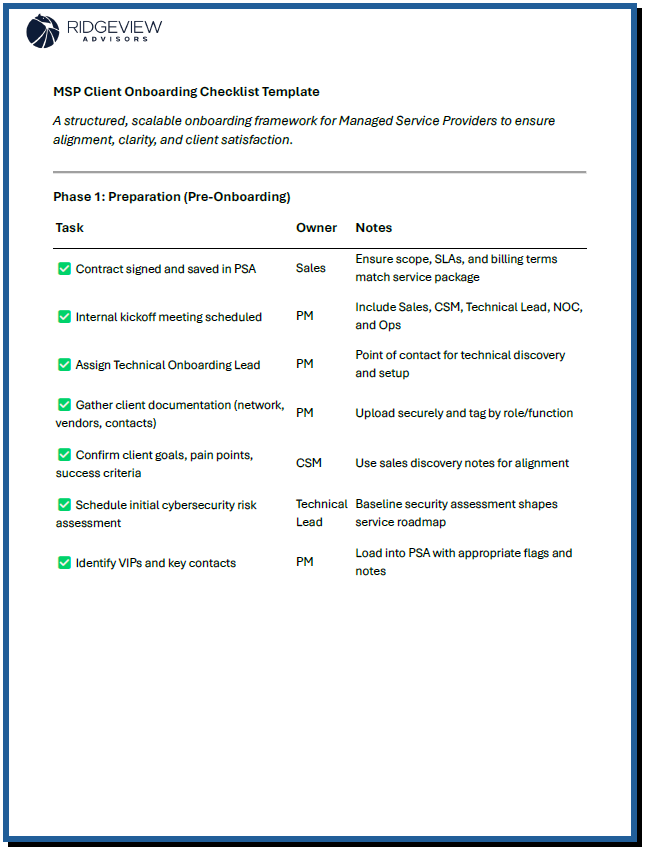
1. Preparation (before day one)
- Signed agreement and scope verification
- Internal kickoff with sales, service, and account management
- Collection of critical client data: networks, users, systems, vendors
- Review of client goals, pain points, and success criteria
- Initial cybersecurity risk assessment scheduled
2. Execution (days 1-30)
- Welcome email and orientation with key contacts
- Deployment of remote monitoring and management (RMM) tooling
- Security-baseline audit and documentation
- Introduction to the helpdesk and support process
- Access setup: email, software, portals, knowledge base
- Account-management introduction and transition plan
- Regular check-ins to confirm satisfaction and progress
3. Transition (days 30-90)
- First Strategic Business Review (SBR) scheduled
- Risk-assessment report delivered and discussed
- Final hand-off from the onboarding team to operations
- Post-onboarding survey or feedback loop initiated
Run the same checklist for every client and nothing falls through the cracks. Every new account gets the same high-quality start, regardless of who’s driving it.
Standardize it, or it becomes the bottleneck
Repeatability is the difference between onboarding that scales and onboarding that drags your team down. If the process is reinvented for every client, it is the bottleneck. The checklist has to be:
- Standardized: applied consistently across all new clients.
- Flexible: absorbs small variations without becoming bespoke.
- Documented: backed by templates, SOPs, and internal tooling.
- Tracked: built into your PSA for accountability and reporting.
That structure lets you onboard more clients, faster, without sacrificing delivery quality. It also gives operations the confidence that what sales sold can actually be fulfilled: no scope confusion, no hand-off chaos.
Onboarding is a process, not a project
Onboarding is where retention begins. A smooth, professional first 90 days builds trust, establishes your authority, and turns new clients into advocates who refer others because of how their journey started. Systematize it. Integrate the risk assessment, align the team around one checklist, and you scale without trading away quality.
We built a free MSP onboarding checklist template (opens in a new tab) you can adapt for your team: pre-kickoff to hand-off, with sample tasks and timelines. At Ridgeview Advisors, we help MSP operations teams turn onboarding from improvisation into a repeatable system their people can run. When you’re ready to build that capability in-house, let’s talk (opens in a new tab).