How to MSP© Podcast · Episode 9
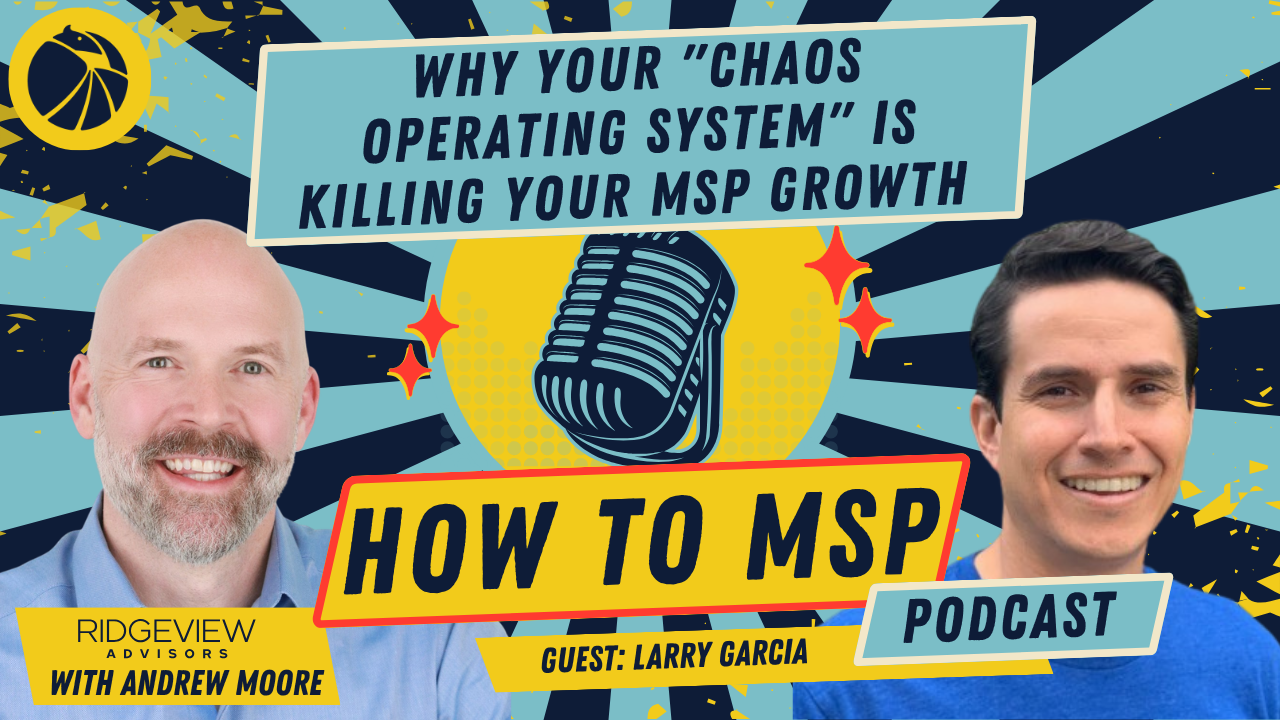
Stop Failing at EOS: Why Your "Chaos OS" Is Killing Your MSP Growth
Larry Garcia of Strety on why running your MSP in reactive chaos burns the same energy as an accountability framework, so you might as well spend it on task.
Watch
Listen
Subscribe on How to MSP© Podcast.
Are you running your MSP on a “Chaos Operating System”?
In this episode of the How to MSP© Podcast, host Andrew Moore sits down with Larry Garcia, President and founding member of Strety and a former BrightGauge leader, to unpack the hidden mental “calorie burn” that keeps MSP owners stuck in reactive mode.
What this episode is about
Larry’s central, contrarian claim: running your business in a state of reactive chaos takes the same amount of mental energy as running a high-performance accountability framework. You’re already spending the calories, so you might as well spend them on being on task. From there, the conversation gets practical about the shift from traditional org charts to accountability charts, the “grace to miss” your early goals, and Larry’s industry-shaking hot take that the next big movement for MSPs might be a return to on-premise infrastructure.
“The chaos operating system in your head of running your business is almost burning the same amount of calories as … an accountable framework where you’re on task, reporting your numbers. … You think it’s double the effort, but it’s really like 15% more effort.”
- Larry Garcia, 10:24
Whether you’re wrestling with “ride or die” employees who no longer fit the seat, or trying to upskill your team for the AI era, this conversation is a blueprint for moving from accidental management to intentional scale.
Questions answered in this episode
- Why “chaos mode” burns the same mental energy as a structured system.
- How to define a role by function instead of by the person currently in the seat.
- What the “grace to miss” is, and why it’s vital for your first 90-day goals.
- How AI will shift entry-level “busy work” into high-level business intelligence.
- Why some firms are reconsidering the cloud and weighing on-premise infrastructure.
Why it matters for your MSP
The throughline maps directly onto the operating discipline we teach: the accountability flywheel that keeps a team aligned, the move to define seats by function so you can build a second line and end the founder bottleneck, and the question of when to hire the leader who owns that accountability rhythm. Larry’s take on AI reshaping task-level work also lines up with where the channel is heading in 2027. The payoff is measurable: Service Leadership’s 2025 profitability research (opens in a new tab) (ConnectWise, 2024 data) found that the highest operational-maturity providers run roughly three times the EBITDA margin of their median peers, and that maturity is exactly what a disciplined accountability system builds.
About the guest
Larry Garcia is a seasoned software leader and the former CRO of BrightGauge, where he helped scale the platform from 90 to 4,000 customers ahead of its acquisition by ConnectWise. He’s now cofounder and president at Strety, a platform built to help MSPs and EOS-led companies actually run EOS. Based in Arlington, VA, Larry pairs deep operational expertise with a passion for helping entrepreneurs move from chaos to control through proven frameworks.
Resources mentioned
- Guest: Larry Garcia, LinkedIn (opens in a new tab) · Strety (opens in a new tab)
- Book: The Hard Thing About Hard Things by Ben Horowitz (opens in a new tab)
- Music: Pat Green (opens in a new tab) · A Tribe Called Quest (opens in a new tab)
- Also mentioned: Cambient.ai (opens in a new tab), MSP anti-phishing software
Ready to stop reacting and start leading? Subscribe to the How to MSP© channel for more deep dives into the business of managed services.
Chapters & timestamps
- 00:00 Introduction & the "Grace to Miss"
- 02:48 From teaching to big data: the BrightGauge story
- 04:37 Traction, EOS, and the origin of Strety
- 10:30 The "Chaos Operating System" vs. accountability
- 13:53 Right people, right seats: managing "ride or die" loyalty
- 18:30 Role-first thinking: the accountability chart secret
- 23:20 Business religions: EOS, Scaling Up, and Pinnacle
- 33:30 Aligning the 10-year North Star
- 36:13 AI in the channel: the death of "task-level" work
- 47:37 Hot take: the on-premise movement (the $5M Basecamp exit)
- 50:45 Rapid fire: The Hard Thing About Hard Things & A Tribe Called Quest
Transcript
The full transcript is on the page (crawlable for search), collapsed for readability.
Read the full transcript
Larry Garcia (00:06): you know, giving yourself the grace to let things change as you get more data. Um, I think people, you know, they, they, they tend to be trying to be perfectionist. Or they think if they do something, it's going to be a big win right off the bat. I think again, if you give yourself the grace to miss, I think it could be really fruitful for your business.
Andrew Moore (00:24): All right. Welcome to the how to MSP podcast. I am your host, Andrew Moore with Ridgeview advisors. And today I'm very excited to have a friend of mine from the channel. We have party together. We have hung out at conferences together. We have talked about the channel together. This is Larry Garcia, formerly with bright cage, but now with Stretty. He is a founding member of the organization and president.
Larry Garcia (00:32): Okay.
Andrew Moore (00:53): And I am super excited that he's here with us on the podcast today. Hello, Larry.
Larry Garcia (00:58): Andrew, how doing? Great to be here.
Andrew Moore (01:01): It's awesome to have you here, sir. So physically, where does the podcast find you today? Where are you located,
Larry Garcia (01:08): I'm in Arlington, Virginia. So I'm just across the river from DC. So it's a real, real quiet time of, uh, last eight years here. Uh, I should just moved here four years ago. So moved in 2021, but in Arlington, Virginia, but I hailed from Miami, Florida.
Andrew Moore (01:17): Ha ha! right on. Did you guys get hit with all the snowmageddon stuff too, or is YouTube too far south for that?
Larry Garcia (01:29): No, we did. was wild. It was this mixture of, you know, four or five inches of snow, but then it was like another five inches of sleet. it made what they, you know, snowcrete is what they called it. So like the plows, plows were getting stuck. I actually saw a plow slide down a hill and it was, it was a wild week and a half essentially. Yeah.
Andrew Moore (01:48): That's crazy. That's crazy. Well, I hope I mean you seem like you're no worse for wear. Okay.
Larry Garcia (01:52): All set now, all set now. Yeah, everything melted finally, but it was, again, was a weird 10 days, you know, it's like the salt could hardly melt anything and it was crazy here for sure.
Andrew Moore (02:03): Living in Texas, it's not really something that we, I mean, I got, we got some ice and then I got stuck. Like I'm in a brain, I'm in my new house in Austin and I'm not used to it I'm from Houston where it's all flat. And so when they got ice in my driveway, my driveway is kind of pretty good angle on it. And so I was just like, I was like, yeah, I'm just going to put my truck in four low and I'm going to get out of here. Yeah, no, that did not happen. And my truck was like, no, we're not going up this hill. And so I was just like, well, I'm just going to be stuck here for a couple of days. So lesson learned.
Larry Garcia (02:07): Haha, Hahaha. Yeah, yeah.
Andrew Moore (02:32): Listen, so why don't you tell everybody about your background, a little bit about what you've done in the space, why people should listen to you. Like, where's your experience at? Kind of what your background is in our in our in our fair channel here, sir.
Larry Garcia (02:48): Yeah, like the sort of TLDR for me was, you know, out of college in the finance world. I had a stint actually being a public school middle school teacher, which is a whole another great story, but I almost went back into finance. But at the last second, my now co-founder, Brian, he had he had just started Bright Gauge in 2012 or 2011, really in 2012. They were growing a little bit. And he's like, look, I'd love for you to join me. And, uh, you know, had asked him about tech advice because he had previously worked at IBM. Then he was working in his family's MSP. And I said, you know, I'm interested in tech, you know, why I might go back to Deutsche Bank. And, uh, he's like, Hey, let's have a conversation. And he's like, look, I started this startup. I can pay you a teacher salary, which was $38,000 in Miami, Florida. Uh, and it was like, okay. And he's like, I don't know if this is going to work out, but it would be a lot of fun working together. And you have sales experience from your finance days. And so I was like, yeah, what the hell? Like I'm making a salary now, no inflation, right? It wasn't like I wasn't dead or anything. And so I took a shot and I was interested because it was, you know, back then no one says the word big data anymore, but back then that was like the hot thing, right? Like whatever AI was and now whatever crypto was three years ago, big data was like that 2010s, 2011, like everyone was saying it. No one knew what it was.
Andrew Moore (04:04): Yeah.
Larry Garcia (04:12): And Brightgift was sort of in that space. was like, know, worst case scenario, I learned something interesting for a year. And so joined and, and man, we really grinded it out, ended up surviving. You know, we went from, you know, losing 23 customers a month and gaining 20, or that math doesn't make sense to, you know, growing to 4,000 plus customers. So a successful exit. So yeah, it was a, it was a great journey. And then we.
Andrew Moore (04:28): you
Larry Garcia (04:37): During that journey, had someone give us the Traction book, which quite a bit of MSP owners have either read it or they've got it behind them in their bookshelf because that book is a pretty popular thing to see at a lot of MSP owners' I remember chatting with them in the Breitgage days or even the Stretty now. They're like, yeah, I have the book. I've never read it. Someone gave it to me five years ago, a friend, a colleague, somebody at the Chamber of Commerce, et cetera.
Andrew Moore (04:59): You
Larry Garcia (05:04): We started doing it at BrightGage. was pretty transformational. We did what would be called self-implementing, which is we read the book and we just said, all right, let's just do this. And it went really well. It was a really solid structure for us. then yeah, we were like, man, we need a tool for this. And back then, you know, there was no real software. So we just built it as an internal tool, right? We had some devs on it and built it as an internal tool. We gave it a project name and we ran our meetings and everybody who remembers a Microsoft DOS terminal. That's what it looked like. It was pretty simple. You know, was like, do you have an issue? If not, it just rolls over to the next meeting, but that was pretty much it. ⁓ and then we, you know, we ended up commercializing it, right? We had a lot of MSP owners that were using our competitors and they're like, we think you can build something better. We have always enjoyed the bright gauge experience. Like, can you bring that sort of user interface that sort of that in your, your knowledge of. of the data space. And so we commercialized it in earnest three years ago, just about. And ⁓ yeah, we grinding it out. We got a license from EOS Worldwide and we've been steadily growing in that space. And MSPs are our biggest vertical, but now we've got companies like Duracell or Equinix and stuff like that on the platform. So pretty exciting journey here the past decade and a half.
Andrew Moore (06:29): That's awesome. I do remember Brankage, because I just remember at the time when we were ⁓ very early on trying to figure out where all of our stuff was, whether it was, think originally I used it with ConnectWise, but then we tried to use some component of it. We used a graphic display system for Kaseya, and then we were trying to integrate. it was really, really hard back then.
Larry Garcia (06:50): Yeah.
Andrew Moore (06:57): to take the data structure that you would get out of ConnectWise and get anything really meaningful out of it so that you could display what was going on. So was a lot of just hunting and pecking and using their reports to try to look at data kind of in the past. And so
Larry Garcia (07:02): Yeah. Yeah.
Andrew Moore (07:11): the big data element of it, I remember because everything was, know, at that time we were moving to the cloud and data was becoming easier and easier to keep lots and lots and lots of. So I really, really liked what BrightGauge did. in order to create that graphically. And I can see how now that you talk about the bridge taking information that is disparate and mostly unactionable and turning it into something graphical and potentially forecastable and actionable was a very easy transition to get to where you guys are today. Well, I oversimplify you make it look easy, but to get it into Stretty and to make it look like something that people would would understand is that.
Larry Garcia (07:41): Yeah. Yeah.
Andrew Moore (07:52): more or less kind of the thought process around creating something like Stretty? Is it to take information that's kind of unstructured and give it some sort of life or accountability? where do you guys really kind of see what you bring to the market? And what does that look like for MSPs for your product?
Larry Garcia (08:09): For sure. Yeah. I mean, it's, you know, our algorithm is always to be on the cutting edge, but not the bleeding edge. Right. So even in the, the MSP breakage days, like we were second or third or fourth to the market, but we were late enough that we could bet on cloud back then. Right. And so we ended up wiping out our competitors because of that. Uh, cause back then I remember, gosh, I still remember this is 2013, beginning of 2013. And I had people was like,
Andrew Moore (08:16): Mm-hmm.
Larry Garcia (08:37): I'm not moving my data to the cloud, which was like, are you sure? everybody, know, American Airlines is on the cloud. But the, you know, and that stuff, and that's really helped us here too, right? So same thing, like you said, there's, all these various tool sets, meetings, OKR slash rocks, KPIs, all these things are all over the place and you can centralize them and relate them to each other.
Andrew Moore (08:45): Yeah.
Larry Garcia (09:04): That's really been a huge success for us both at Brightgauge but here in Australia as well.
Andrew Moore (09:09): That's, that's one of the reasons I wanted to have you on today was because when I work with my one-on-one coaching companies, I often find that some of them are already using like 90. Some of them are using Stretty. Some of them have got a spreadsheet that they use. Um, and what I really find fascinating is even if they're able to start putting the information in one spot, A lot of the times they really lack the understanding. You talked about self implementation of how to create any accountability out of that information. And I feel like there's a real disconnect between we're using a tool and we're actually taking advantage of what the tool provides us in a way that we can impact our business. You brought up a good point. People are like, I've got the book. I've just never read it. Where, where do you, where are you seeing people that are more successful with using Stretty, where are you seeing people that are actually transforming their businesses when it comes to accountability? How do you coach them through that with your user groups? What does that look like in your world, like with your product?
Larry Garcia (10:24): Yeah, I think a lot of it is like, we always tell people, like, the first thing you got to do is go make it wrong, right? Like, go try something. and go get a bunch of nos or reds or missed rocks or missed goals. Like go get that. that, the first goal should be to go miss, right? Like, but to just get and start doing something, right? Cause I think a lot of times the traction book sitting there is just like, ⁓ I'll just continue doing what I'm doing now. It's worked for so long, right? What's interesting to me though is like, it's like the same calorie burn. Right? Like the chaos operating system in your head of running your business is almost burning the same amount of calories as like an accountable framework where you're like on task, you're reporting your numbers to someone doing all that stuff. Cause you're still kind of thinking about it. Like it's something good or bad, right? Like maybe you're not writing down a number and there's like a little bit of more effort spent on like finding the number and reporting it back, but it's not a lot more, right? ⁓ It's kind like one those crazy things where like someone is like a a 5k runner, right? Like you're really just burning like 20, 30 % more calories than if you just sat all day, right? So it's like not that much. So it's very same sort of analogy to business. Like you think it's like double the effort, but it's really like 15 % more effort. So once we talk to people, we say, we kind of get them the story. We're like, look, just go get some numbers, go pick two goals for this quarter. Like we'll get to the. EOS three to five per person across the company. You'll get there in a year. But for this, like go protect two goals for this quarter. And let's just try to hit one. Right. Like and you might whiff three weeks in, you might be like, ah, this doesn't make sense. I frankly, I just came off of an annual meeting where we I had this goal for the quarter and I was like, all right, I've got Larry's got his three goals three weeks in. Two have already dropped. I'm like. I'm not going to hit this goal. And I just got some data back from the market real Mike, but this one goal is super important. Like it's more important than I thought it was. And so I've been ultra focused on that goal. That one's super healthy. I'm definitely going to hit it by this quarter end. And again, I dropped 66 % of my goals and things, you know, giving yourself the grace to let things change as you get more data. Um, I think people, you know, they, they, they tend to be trying to be perfectionist. Or they think if they do something, it's going to be a big win right off the bat. I think again, if you give yourself the grace to miss, I think it could be really fruitful for your business.
Andrew Moore (12:58): I agree with that. had a conversation with a couple of my clients over the last few months, and specifically with their service delivery team. And one of them said, that data looks really, really bad. And I was like, that's great, because that means you have a place to improve. yeah, your SLAs are trash. Let's fix that. If you wait to report on everything until it's green, then there's no, in my opinion, I don't think there's a reason that you'd
Larry Garcia (13:13): That's good. Yeah, yeah. Yeah.
Andrew Moore (13:28): need to report on it because it's green. Like if you're waiting to fix everything before you start looking at it, how are you going to know where you can make improvements? I don't like that at all. And one of the things that I find too is when people really get into EOS and they start with the executive leadership group, I have found sometimes that ⁓
Larry Garcia (13:35): Exactly. Exactly.
Andrew Moore (13:53): There's a lot that goes into as they begin to work through that process, like right seats, right people. Is there anything to people, I guess, being hesitant to start that process because they're afraid they're afraid that if they start looking under those rocks and no no pun intended towards the actual rock, but if they start looking in places where they're just like, I think there's some smoke over there and there's this person that's on my leadership group or in a like a lead position.
Larry Garcia (13:58): Yeah. Yeah.
Andrew Moore (14:20): And I'm just worried that I may have to make a change there. Do you have any sort of philosophy around that? where do you start to look when it comes to how to assemble that group? And if they know that there may be some issues, like pulling off band-aids, what does that look like when you all talk to people? Or what experience have you had in your own businesses where you had to deal with that?
Larry Garcia (14:39): Yeah, I mean, that's tough. mean, we've had it part ways with employees in the bright gauge days and there were some people that were super early on. And what's funny is things change and evolve, right? Like what they fit perfectly two years prior. right, like didn't exist anymore, that world didn't exist and it just weren't a fit anymore, right, as the way the company has evolved, because the company itself is an organism. So I think one thing that's interesting is like, if you start asking yourself the question, all right, there's kind of a smoke and you know, that someone's kind of like, always negative and they don't fit the core values of the company and all this stuff, but they've been on for, you know. for lack of better term, what they call ride or die, right? Like they were early with you. They were great. They were hustlers. They kind of got you to where you were and you've got a lot of big sense of loyalty, right? If you ask yourself the question, hey, if I go into the future and they're at a company where they're super happy, they're super, align with that values of that company, right? Like, why would you stop them, right? If they came to you and said, hey, I found another company where all that stuff. So I think one sense is have the conversation. But work with them, work with them. like, Hey, like these, this is what we need. This is what you need. It kind of doesn't mesh right now, but let's have a conversation and maybe we can't get there, but like, doesn't mean you have to fire someone the first conversation, but you can say, Hey, let's work towards something. And it becomes very evident. You know, some people are a little bit more aggressive. Some people are like, Hey, this is wrong person, wrong seat. Let them go free them all that stuff. ⁓ me, it's like, just be open and honest, right? Just be open and honest of what we need. Be open and honest about what they need. Where does it fit? Can changes be made either at the organizational level or at the personal level? And if it fits, let's build a roadmap. Like, what does that look like? Maybe they become a consultant, right? Like maybe they're not on the books as a W-2, but like they sort of some function that they really appreciate of their job. They just don't like the new thing. And maybe they're just a contractor for a while while they figure out that next, you journey. So that's something that we said, Hey, just start having the conversations, identify it, have the conversations. And there's, multiple ways to get to that same door, right? It's the more aggressive way and then the more, thought out, you know, time being patient way.
Andrew Moore (16:56): I think one of the areas that I see happen when it comes to right seat, right person, well, two different things. One is I feel like a lot of the times owners in various businesses, whether it's an MSP or not, or people in leadership positions assume that everyone at or above their level at the leadership level has the same toolbox. Right. have the same abilities to do things where they figure things out quickly and they're self motivated and they don't need a road map and new and interesting ideas don't scare them. And ⁓ and they're just like, I don't understand why this is hard. Why is this person not being successful?
Larry Garcia (17:28): Okay. Okay.
Andrew Moore (17:41): And and you're and you and I think it takes a lot of scar tissue as a leader to realize everybody. When you say it out loud, people are like, well, yeah, that sounds stupid, Captain Obvious, but like everybody's different. Right. Everybody's got different skills and inventory.
Larry Garcia (17:41): Yeah. Yeah.
Andrew Moore (17:55): So how do you recommend organizations using these frameworks start to have those conversations? You said, hey, you need to start creating roadmaps, talk to them about stuff. What does it actually look like when you say that? How do you start the process of saying, here's what your job role is, and this is what we need out of you? And where do you start? Do you start with a job description? Do you start with? you daily tasks, you start with KPIs or OKRs, where do you start when it comes to having those conversations with people so you can show them a baseline of what good looks like and help them to understand what fit and function is in a role?
Larry Garcia (18:30): Yeah, for sure. mean, we definitely leverage the accountability chart in our thing, which is the way of doing the org chart, where you kind of do it by the roles and not by the person. The traditional org chart is here's a person who reports to them and cascading down to the mail clerk at the bottom. In the accountability chart, you just say, all right, what are the roles that help this company function? Right. And I think we, you build that out first without even reference to the person you say, all right, in this role, what do they need to do? And it is that what does it need to do as a job description? What are the deliverables and the KPI for that role? Like, Hey, in this role, you know, a sales development rep, like what do we need? We need 80 dials. need. you know, 20 conversations, we need two meetings booked, right? And so there might be some KPIs there, right? Job description is you show up, you have a positive attitude, you make the dials, right? That there's some will, you know, skill you can teach. So we might put that in the description and then we say, you you fit and we do a pretty good job too in hiring of using that as well. So that's a little bit. ⁓ comprehensive to do, but it's helpful both to having current conversations with people in the right seat that been around a long time. It's also helpful for recruiting, right? Of really aligning of what our expectation is. ⁓ but yeah, we'll do the whole holistic thing. The, what are our KPI deliverables or the daily tasks was the description and what type of person are we looking for for this role?
Andrew Moore (19:59): And as you go through that process, I have a hard time, just me personally. So I'd love for you to dig into this just a little bit. Talk about the accountability chart. I honestly get really kind of frustrated and confused about accountability versus org chart. And I'm just like, ⁓ like, can you give educate me, talk to me a little bit about the difference between accountability and org chart and why you prefer accountability and where org chart works. But like, give us a rundown on this, because I've tried to explain it to my clients in the past. And I finally, honestly, I just give up and I'm like, org chart, just use an org chart. Where do you what's your thought on that? How does that work?
Larry Garcia (20:34): Yeah. What's at some point you probably need to definitely have an EOS implementer in here for sure that that would give you a real great answer to this. But you know, it starts at the top where we say every company has a visionary and an integrator, right? There's someone who is at the top of the crow's nest is like, this is where we're going. Right. But then someone's got to make the trains run on time. And that's the COO role that Andrew you're very familiar with. Right. So
Andrew Moore (20:59): Yeah.
Larry Garcia (21:00): Who's going to make the trains run on time? Who's going to make sure operations are running well? And that's that they call the integrator, right? They kind of have their hands in a lot of different places and definitely at the leadership level and they're leading, they're managing, they're seeing if people are accountable, is, you going to do what you're going to do? Right. And what you do is after those people, then you're structuring functions, right? Like who's the sales leader? Who's the marketing leader? Who's the technology leader? Who is the CFO, right? Who's doing the finances? And multiple people can sit, ⁓ not multiple people, multiple people can sit in each individual seat and you can be in multiple seats. So for example, ⁓ know, I, I right now I'm in transitioning from integrator to the visionary role, right? It's just that, that season of strategy is I, it makes more sense for me to be in that role and my co-founder and I are swapping, right? But I also lead marketing and he leads the CFO function, right? So he handles finances. and I handle sort of the marketing seat. And so you can be, your face could be on kind of all these multiple things in here. And it is like who reports to who, but as a function, as of, if you imagine that this company was just on Sims and it wasn't people, it was just, you know, you know, mechanical thing, like this reports to this reports to this, is how you would structure it. Like, and then you say, all right, fields of leaders. Now, another thing about the accountability chart, why it's interesting is You can fill it with contractors, right? You can fill it with contractors. can fill it with consultants, right? You can fill it with a fractional bookkeeper, for example. And so that tends to be a little bit cleaner than the traditional order chart that has all the W-2s on there. And then on some box on the side says, hey, we pay for some third party services. Like now in this accountability chart, you say, hey, we've got a bookkeeper and they're accountable for keeping our books clean and accounts receivable and accounts payable up to date.
Andrew Moore (22:54): That's super helpful. ⁓ When you talk, you just mentioned getting an EOS implementer to go deep into some of this stuff. ⁓ Why did you guys land on EOS? Like what other frameworks are out there? What do people need to focus on when it comes to accountability? know you guys prefer EOS. You like EOS. You're accredited there. But are there other things that companies use to drive forward with accountability and, you know,
Larry Garcia (23:20): Yeah, yeah, there's a good amount of them. a couple that come to mind are Scaling Up is one. There's a gentleman named Vern Harnished who he wrote The Rockefeller Habits, which is a great book. And I think he was actually the founder of EO, which is a pretty popular sort of peer group in the MSP space or SMBs at large in the US. ⁓ So scaling up is one pinnacle is another one. Uh, some people do racy. Some people do just, okay, ours, right? So it's, it's, you know, the, the objectives and key results and you're, you've managed the whole company off of, okay, are essentially goals across the organization. Um, so there's a couple of different ones, but it's, it's kind of like, some people do jazz or size. Some people do crossfit. Some people do, you know, a bar class. Some people do just weight training and stuff like that. It's, The ultimate goal is just to be healthy, right? And there's just a of different ways to do it. And there's some clean overlap, right? There's nothing new under the sun. A lot of this stuff is about, you know, having healthy meetings, having good goals, having a good vision for the company and everything in the middle. So.
Andrew Moore (24:31): I found that EOS, I remember when I read Traction, so I've read, well, back in the day, I have probably read every business process book on the planet. it felt like this, whoever, felt like the founder of the guy wrote Traction. ⁓ He's like, I'm just going to pull from every single one of these different processes. it's what, to your point, it's like, it wasn't anything new and whatever EOS had come out of.
Larry Garcia (24:57): Yeah.
Andrew Moore (24:59): felt like it came out of Rockefeller, Hafen, Some Good to Great, and like all these other different books. I, to your point, it's almost like a new, it's like a new business religion that was compiled from all these other ideas of, of, know, where people go. And I think you and I were talking earlier where, you know, from my perspective, when I work with a client,
Larry Garcia (25:03): Yeah.
Andrew Moore (25:24): I used to think, and I think it's Buddhism, they say that all all attempts at enlightenment are heading towards the same goal. But I don't feel like that's the way it is when it comes to accountability. Just because you have a weekly meeting doesn't necessarily mean that that's moving in the right direction towards accountability. Like you're not heading towards nirvana. You actually might be moving in the wrong direction because you're not using a process or a tool. Can you just touch base a little bit on like where you've seen in your own work or where you're seeing your clients, why is having a process where a system, why is picking a religion and creating a dogma and using some sort of a tool in order to structure that? Why is that so important to a small business and why are people failing to actually do that?
Larry Garcia (26:13): Yeah, you know, I think it's interesting because it's like, it's what you don't know is like the effect of one thing in the business affecting something else, right? The ripple effect across, right? Like, hey, this meeting goes poorly because there's a... problem, right? But that problem could be solved by a really good 90 day goal, right? And that's kind of a different component, right? Outside the meeting. And so I think having that framework is what's super helpful because if not, you're just going to have the chaos operating system running the chaos operating meetings, the chaos operating goals, the chaos operating accountability chart, the chaos operating 10 year vision, right? The 10 year vision is kind of like a, something, right? We're going to grow, right? We will be bigger than we were today. We bigger 10 years from now. And it's easy, right? It's the default, you know, it's the inertia. What this stuff does is it like, kind of makes you, you know, like when someone goes to work out, like they go get a trainer. Like if you can imagine, there's this study where it's like, Hey, if someone gets a tutor, like they tend to outperform the mean, like some crazy number, right? The only problem is that you can't get a teacher for every single student in the U S. but if you do, and that's the possibility of AI, and I'm sure we'll dive in AI here in a second is the fact that, know, getting that framework is almost like that tutor, right? It's like, this is what you do here then, right? And I had a, I remember I had a, I went to all boys Catholic school in Miami and I had this priest who always be like, you know, Larry, everybody wants the resurrection, but they don't want the crucifixion. And so that's the key thing of the framework. Putting the framework in is, is, going to be different than what you're doing, right? But it's having that sort of sustained effort and following a recipe, right? is always gonna be better than not, right? Regardless if it's EOS, regardless if it's some other framework, regardless if it's something that, Andrew, you just say, look, I've had experience and here's the 10 things you should do. Like if someone follows those 10 things, they're probably gonna be a lot better than if they are kind of just haphazardly doing things.
Andrew Moore (28:13): Yeah, I found that a lot. I have a home gym. I'm really excited about it. was like, can't wait to have this home gym when I moved into my new house. It is really hard to go in there like like I wake up early, you know, and I'm like, I'm gonna go get some coffee and I'm gonna go work out. But I know if I don't put up my clothes the night before and I'm not focused or maybe I had a beer like it's just it's not something I do. And I think that that comes back to anything. worth doing. It's just the momentum of it and the process of starting something from scratch, especially starting something that you might suck at. Right. Like you're not going to be great at building an accountability system the first couple of months. It's just not. And I think the overwhelming this of it coming back to what we had talked about earlier, which is don't go in and try to eat the elephant whole race. Start with
Larry Garcia (28:59): Yeah.
Andrew Moore (29:12): one KPI, start measuring something, start with one rock per person that's achievable. ⁓ When we talk to our clients about those sort of things, I feel like everybody gets lost in the sauce about, I'm going to try to implement this new system to run my business. And I guess it's just not that complicated, right? I mean, I know at some point, if you use it long enough, it gets fairly in depth. But I mean, people shouldn't make this into something it's not, you're just picking a path and choosing to make an effort and organize yourself in some way. And you don't have to make it up from scratch, right? Like, it's not magic. So from from that perspective, ⁓ you know, where do you start to tell people like,
Larry Garcia (29:48): Yeah.
Andrew Moore (29:58): When you go in, do you do the whole VTO thing first? What do you recommend to people who are just starting down this path? Where do you all set the bar to start saying, when you get into the systems, just do the minimum four or five things. And then if you're doing that week over week, let's move on to the next thing. What does that look like in your space with your clients? How do you guys handle that?
Larry Garcia (30:00): you You know, it's funny, my answers evolved, right? Cause we self implemented in the bright cage days. from 2016 to 2020, when we're at the business, it was, you know, reading the book and implementing it. And I would have answered this up until probably January. I would have said, you know, the most important thing is just get the weekly meetings right. You know, like just run your weekly meetings, have a place to communicate. dump your issues throughout the week, right? The fires you have to fight that day, like you just find that day, but the fires that can wait a little bit, or at least until the next weekly meeting, like that's going to give you some savings there. And that's what I would have told you before January. We finally decided, Hey, you know what? Like it's really time for us to start using an implementer. Like a third party who's kind of like spot checking us and teaching us, facilitating the annual meetings and all that stuff. And so we contracted with a lady by Lisa Gonzalez, and she actually wrote the process book for EOS Worldwide. And gosh, now I want to tell you is like, really what you should do is the key stakeholders in the business should sit and say, all right, what do we want? Like, what do we want to do? Like, can we all agree? And I think what that does about starting sort of further out, as opposed to what I originally would tell you about the weekly meeting, is like, it kind of helps everybody align to, okay, what are we going to do in three years? What are we going do in a year? What are we going to do this month? Well, all right, how does it line up to 10 years? Does, you know, we want to grow, does cutting our SLA down this quarter, align up with us growing? Probably. Like if our SLA is better, our customers are happier and they're probably referring us business. Let's do that, right? Hey, should we go start ⁓ an AI consultancy? maybe, maybe not that has a little bit more risk. Like there isn't a straight path to growing the MSP business there. Maybe there is like, but you can have a debate around it, but always at that North star, what do we want to be in 10 years? And so now it tells you, yeah, I think starting with that, what's, what do you, where do you want to be in 10 years, know, chunking it down to three years in one year, uh, what are the core values of this company? Like who do you want to, what type of person do you want to work with? What's important to them? You know, ours at, as Strati is we want humble people. We want passionate people and we want good people, right? know, hey, would I trust them? know, if a wallet got left behind, would I trust them? they good people at heart? Yeah, you know. Are they humble, right? Like they work hard, but like it's not, it's not, ⁓ everybody loves me. I do everything perfect. Like, you know, we don't want to work with people like that. It's just exhausting to us, right? And, you know, are they passionate? And the passionate thing is interesting. We always hired this and we had the same people. or the same core values at Bright Cage, which was, are you passionate about something else? We always thought if you're passionate about playing guitar, the railroad tracks are there to go be passionate about providing good service. You know what it's like to put your head down and be a master of your craft because you play an incredible guitar. You know that when you got to go serve a customer and customer success or sales, you've got those railroad tracks. You know what that looks like. So you've got that muscle memory. And so we wanted passionate people. didn't have to necessarily be passionate about the MSP industry.
Andrew Moore (33:30): I love that you talked about getting everybody aligned at the leadership level. I've had a couple of coaching engagements and some things that have happened in my prior life with other MSPs where there was a conversation where there were two owners or partners in some way with the business. And when the conversation was, want to grow. One of them wanted to grow into a more profitable lifestyle business and the other one wanted to grow into a platform based MSP. Like, so sometimes these things happen where you realize if you don't look at the five year, 10 year plan, when you say we want to grow everybody in the moment is like, well, hell yeah, we all want to grow, but maybe we don't want to grow to make $20 million because that just seems hard and a lot of work maybe.
Larry Garcia (33:59): Yeah. Yeah. Yeah.
Andrew Moore (34:19): maybe we want to grow to do three. And that uncovers a lot of dissidence between what's going on in the leadership group, which I think is really important because I believe that manifests itself in the chaos meetings because people are at odds with what they corally want to see out of the business and what they want from themselves personally. And if that isn't aligned very early in the process, it doesn't matter. how much agreement happens on what you're doing on a day-to-day basis. There's always going to be an underlying frustration about what the actual goal is to achieve what you're trying to get down on paper, if that makes sense.
Larry Garcia (34:57): Yeah, the ripple effect on hiring, you know, do we hire that additional person? That's going to hurt your profit margins. And so one person is going to not want to hire someone. The other person is like, well, we kind of need that person on mergers and acquisitions. Like, hey, do we go hire, you know, acquire a smaller competitor? If you're a platform play, yes. If you're a margin play, then the number is going to be really tight, right? And maybe you can't acquire them. And so yeah, that ripples down to a ton of decisions down the road if the two are aligned, right? the company is not aligned.
Andrew Moore (35:27): So you brought up AI. What was the question? CNBC a couple of days ago, and the market was doing weird stuff. And I guess recently they've coined, not them, but the markets have coined SaaSpocalypse. So everything's changing. And everybody in the MSP space is scrambling to try to figure out what to do with AI within their own business, how to help their clients with it.
Larry Garcia (35:41): Yeah Thank
Andrew Moore (35:56): What are you seeing with your business? What are you seeing when it comes to coaching and accountability? What are you seeing when it comes to how people are running their business when it comes to using AI? What does that look like for y'all? And what advice do you have for the folks out in the channel about what to start thinking about?
Larry Garcia (36:13): Yeah, I think it's always wise to dedicate, you know, one, two, three percent of your resources to learning about it. It's not going to go away. Right. And then it just depends on your philosophy of do you think it's going to end the world or not? Personally, I don't. I think it'll be a very useful tool. I think it'll be transformational, like the Internet was transformational. But I'm less of like a doom and gloom person just because at the end of the day, it's like I know I don't want another spam call. I already get those, right? Like I'm already getting them. Like is, is an AI claw bot dialing for someone and me getting 10X more, more spam calls is going to make me buy something or something like, no, like kind of doesn't matter. Right. And so somewhere to definitely research, be interested in, do a little experiments. There's a lot of great vendors in this space, space like. I know Thread is super into that AI, you trying to resolve taking stuff like that. There's others, Pia is another one. It's fantastic in that space. So I think it's something to research, be on top of, definitely not be, I think it's, I don't know if I pronounced it right, but Luddite or whatever it is, like you don't like technology. I forget the pronunciation. Luddite. Definitely not be that, obviously you don't want to because your customer is going to ask you those questions. So be educated in it.
Andrew Moore (37:24): The Luddites, yeah. Yeah.
Larry Garcia (37:33): be using the paid version, the $20 version of these things, test things out. But I don't, you don't think, if you think of like, you know, I heard this was like salesforce.com, right? Like people have a weird relationship with salesforce.com. They're like, ah, it's a CRM, it's expensive, all that stuff. That thing has had, probably this year, 130 or 40 bugs that have been reported and fixed, right? Can you imagine someone with a... a lovable account, creating a Salesforce and then putting your customer data on it and be like, Oh, it's been published to everybody or, you know, it's accessible. So there's a lot more to SaaS than just simple, you know, making a wire frame and doing this thing. If the eventuality, yes, there's a future that, you know, someone can just say, Hey, I want to fitness app and it's going to be created. But at the end of the day, like, I just think it's further out than we think.
Andrew Moore (38:27): Yeah, I've been what I've been trying to figure out how to do personally is create a way that you can actually expand your knowledge within your organization so that other people can get very similar advice or information that they could get without bothering you. Right. So like, as an example, if there's some way of being able to go ask the Larry bot, like, tell me about this.
Larry Garcia (38:51): Yeah
Andrew Moore (38:57): within Streti, it would be really great that it would use a ⁓ source of information within the organization files or whatever and just say, is what our core values are and this is what we want you to do with it. And here's how I would tell you to solve that problem. I think there's something there to taking, talked about big data, certain levels of unstructured information, trying to create a way, in my opinion, that you can you can build better processes and explanation for how things work. Because I heard a guy on, I'm going to vamp for a second. So I heard a guy the other day on a podcast and what he said was he's an AI expert. And he said there was a path that people have taken for like 4,000 years on learning. And the learning is you go, you know, very little about something and you work with a mentor and that mentor helps you to understand it. You get better at it over time. Right. And what we've seen lately is if you take an intern, which is very much in that vein, and you put them at a company, well, what they're going to be doing is using AI to help them with what they're up to, even if they've got somebody who's been assigned to them as a mentor. That mentor at some point is going to realize, that person's just using a bunch of AI to interface with me, so I'm just going to use AI. Right? And so what that's going to wind up doing is
Larry Garcia (39:54): Mm-hmm.
Andrew Moore (40:17): people who are now managing and
Larry Garcia (40:18): you
Andrew Moore (40:19): are being given responsibilities within a company, they're going to have to understand how these different AIs will interface with them to help them do their job. But it also eliminates a lot of the task level work that these interns and other folks did. So now that person is responsible for having to understand at a higher level how their business works, how processes should be managed, what that looks like. And so the requirements of these managers and people that are going to be moving into business
Larry Garcia (40:19): Yeah.
Andrew Moore (40:47): this is this guy's opinion, which I kind of like, requires them to be smarter about the company, smarter about the business processes. So it doesn't actually eliminate jobs in a certain capacity. It just requires that those jobs have to be up skilled in a very different way. And the level of accountability for what those people do is going to look much different today than it does in three years. That was an interesting opinion. I don't know if you have a thought about that, but I look at what you guys are doing with Stretty and I look at what I'm doing on the education side. I feel like there's a movement towards smarter, more accountable people in the business space. And that's not going to go away. think that's going to become exacerbated over the next five years where people are like, everybody's going to lose their jobs. I don't know that that's true. I don't know what you think about that.
Larry Garcia (41:16): you Yeah. Yeah, I think it's going to be this weird pivot back to face-to-face human-to-human contact, you know, being at live events, being out there, you know, imagine. You know, if you're documenting things really well, and there's a spot that's taking care of all the level one tickets for you, like you can get into more complex things, right? You can make into, you know, computer transformation into coaching them on AI. There's just more interesting things you could do. So yeah, I agree with that. It's just like, what are the higher level things we can do and especially in person, right? I think that's where it's been most helpful of like, Hey, ⁓ the more we can have people on meetings and not necessarily like filling out RFPs or filling out. You know, we get asked for like security questionnaires all the time, right? We had one of our engineers, a high level engineer, you know, six figure salary plus, ⁓ filling out a 90 question security questionnaire, right? And it was, was taking two and a half hours that gets done in 30 seconds. Now, do we let the engineer go? No, like the engineers now building features inside of Streti. like that's what's more important. And you know, If they need a security call, then yeah, the engineer gets on the call and discusses like the vision for security, where are we going, all that stuff. Like that's the high value stuff. So I feel like there'll be more of those and less of like security questionnaires and things like that.
Andrew Moore (42:57): I agree. I do think that it's really interesting in the SaaS space, though, that you have the opportunity of being able to kind of test run your idea a little bit. love the idea of being able to, because I think that's going to give, agree with you, I don't think SaaS is going away. I think that you may wind up flooding the market with incomplete product too fast, which kind of sucks. But I also think the opportunity to do test driving on whether you think you've got this idea.
Larry Garcia (43:16): Yeah.
Andrew Moore (43:25): Well, you don't have to have $100,000 to MVP your idea. Like you can vibe code it, see if you think it works, go take it to some friends, run it through its paces, and then go out and look for opportunity for investment or bootstrapping or whatever you want to do to get off the ground.
Larry Garcia (43:28): No. That stuff is super important. And I will say the software world is littered with shitty software. And what there hasn't been is that quick capitalist mechanism of cleaning up shitty software, right? know, people are like, it's built. It's a hassle to move my data, stuff like that. Like we hear it all the time. Hey, I don't want to move from X competitor because it's super hard to move. I mean, I will tell you, we move. 500 employee companies, we move all their data, we take care of everything. It's super, but what do they have? They've got 20 years of muscle memory of like an ERP change they did 10 years ago and it was a huge hassle. People jumped off bridges, like all this stuff, right? And they're like, I'm not doing that, right? And it's like, we're literally just moving your like meeting data from one place. You're just going to different website. Like that's all we, that's the effort, right? Just log in through a different website. You'll see all your old meeting stuff, all that stuff. I think that's what's going to provide. It's going to level up all this, you know, cloud software of like, can't provide shitty software because there's going to be a better one and they can move your data off very quickly because you've got these AI or agents pulling your data and migrating it very easily. But that's good. That's a good thing. That's a good thing for capitalism of, you know, I still remember our, our HOA at our apartment in Miami was on like a, you know, $8,000 a year. like contract just monitoring like the HOA bills and who paid it didn't pay. And I remember like I was in bright gauge. I was like, you guys pay 8,000 a year for this? Like it was like a simple, could have been done on Excel sheet, but they cornered the market in the HOA business. People on the HOA board typically sometimes kind of unpaid. So they don't care. Like just get the same HOA software everybody has. So these people had like regulatory capture of like, they're going to get every HOA board cause it's no competitors. those were the ones that would die, right? And they'd be like, that's probably a good thing.
Andrew Moore (45:34): Yeah. And I, to your point, we see it in our space too, is, you know, legacy vendors and stuff like that. If people aren't moving towards a more flexible software solutions for the market, bloated PSA's or, you know, expensive all in one tools for XDR, whatever those things are. not, you know, I'm not poking at anybody or naming names, but there's software out there that's been around for far too long. And there are other softwares out there that are more flexible that have APIs that allow you to get better bang for your buck. And I think the market at some point, I feel really strongly that the MSP space is at an inflection point right now. I can't explain it. It's my spider sense. I've been in it for 20 something years, but there's an old guard bunch of people that are starting to age out and retire this year that came in that big wave, right? You know,
Larry Garcia (46:14): Yeah. you
Andrew Moore (46:28): in the late 90s, early 2000s, where all that stuff was new and exciting, and we were becoming MSPs and moving away from hourly rates and all that stuff. And now I think there's this new group of people that are coming in in their late 30s, early 40s. They're new. They've got different ideas. And I feel like there's a change coming, and especially with the AI and the ability to quickly iterate on SaaS delivery. Watch out. I think the MSP space is about to get poked a little bit in a good way. Not like I think the complacency of the past is over. And I also believe that the fiefdoms that have been created by the giant MSP providing companies, people are kind of over it. I think people are looking for other avenues to explore without being told you will use this ecosystem of products. I think there's something to it. I really do.
Larry Garcia (47:18): Yeah. Oh, a hundred percent. You know, I think here's my hot take. know, know one of the things Andrew, you said like, Hey, don't, don't shop something that isn't out there, but this has been in my mind for a bit. I, if I had a guess, I bet you there's going to be a big movement to on-premise soon.
Andrew Moore (47:30): Go for it.
Larry Garcia (47:37): I think that there is, I think cause things have gotten so much better and quicker and, know, a gig of, of speed. So if you needed to update software on a server, you could probably update it. I bet you were going to move to this, like people will have these like home servers and run their LLMs there, run some apps and stuff like that. ⁓ I know for a fact, like Basecamp, for example, like they're, they're big firm. ⁓ we actually use the coding language that the CTO of Basecamp created called Ruby on Rails.
Andrew Moore (47:37): Really?
Larry Garcia (48:07): So they just moved off of Amazon. They're saving $5 million a year from their Amazon bill and they just moved on premise, right? Now they're paying someone to host it. So it's like in a server environment, but it's their servers, right? So it's like they're, they pay for the physical boxes. And so I think that that's something that's interesting. And that's really timely for the MSP industry, right? If that is a movement that starts picking pace, cause these people are definitely cutting edge people, but like at some point someone's going to say, Hey, like your business has like these five, know, these, these 25 different SaaS things. Why don't you just use this like securitize open source model inside of your server and run it all there. And I'll handle it for you. Like that could be a really interesting MSP thing to happen.
Andrew Moore (48:51): Yeah, I mean, I think they also that comes back to if you look at what the broader technology market is doing. MSP is always, you know, five years of low because we're mostly focused on the SMB space. So it's really like we're not going to do stuff unless it makes sense for us to sell it. So but you look at that and everybody, you know, 10 years ago, I remember talking to a data center person and I was like, why are you still doing this?
Larry Garcia (49:06): Yeah.
Andrew Moore (49:17): Like this seems like a really bad idea. Like you should probably think about doing something else. Like I was completely ignorant as to what was coming. And so, you know, now you've got, you know, people trying to look for the least most expensive power to push to these data centers, high redundancy, you know, opportunity where they're being subsidized by the government. So you can come in at a much lower cost point. Other than the fact that, you know, RAM is $20,000 a stick.
Larry Garcia (49:17): Hahaha Yeah.
Andrew Moore (49:43): because of AI, mean, running your own compute doesn't seem like a terrible way to, to, you're trying to cut back. Cause I know plenty of my clients are like, I'm spending how much a month on servers. They just, it just keeps ticking up and they don't really look at it. One day they complain about the bill and you're in MSP and you're like, yeah, you're spending four grand a month on two servers in Azure. And they're like, what are we doing? Like what, why is that a thing? Like, cause you wanted redundancy and you just keep adding space to it.
Larry Garcia (49:43): Yeah. Yeah. Yes. Yeah. Yeah. Yeah. Yeah.
Andrew Moore (50:13): So it's crazy. ⁓ Well, I wanted to let you know that I really appreciate you coming on the show today and talking about what you guys do and how you see accountability in the MSP space and what you're seeing in the channel. And so it's just been an honor to get a chance to talk with you and to pick your brain on some of this stuff. So thank you for that.
Larry Garcia (50:32): Yeah, no, thanks for having me blast. We'll definitely, hopefully see each other in Vivo sometime soon at an MSP or all the evolve IT nation, cause say events or something like that.
Andrew Moore (50:38): there. I'm sure we will run into each other. It is the biggest small world on the planet. The channel is, as we always get to see each other, which is great. ⁓ Before we check out, I'm ask you five questions. We're gonna make this quick, because I know you've got things that you need to get done. So we will start with, what is the best book that you ever read that helped you in business?
Larry Garcia (50:53): Yeah. There's a book called The Hard Thing About Hard Things. It was about starting a technology business in think in the 2012, 2013, Ben Horowitz from Andreessen Horowitz. And that was a really good, phenomenal book of just like how hard it is to run a business and all the problems that come across your people process, all that stuff. So that's probably my favorite business book.
Andrew Moore (51:30): All right. And for those listening, will put those in show notes so you will have a chance to go look them up and grab it from the internet. All right. Again, you don't have to say it if you don't want to. What's your favorite curse word? What do you like to what's your soup?
Larry Garcia (51:42): Oh, I, yeah, I have a couple, right? So I'm Colombian. there's some couple ones in there, but I'm going to leave those out for now. would, you know, bullshit's a good one. It's, it's got a, it's good. It's, it's, it's got a good, you you stub your toe, stub your toe, but you can say bullshit and you call someone's bluff or a lie bullshit. So I'm a big fan of that one.
Andrew Moore (51:52): That's a good one. Love that. That's a good one. That's a new one that has not been said yet. So you're in your own space there. That's awesome. OK, so if you have a band or a musical artist that you dig, you're on a desert island and that's the only catalog that you get is that person's music. Who are you going to? What is your go-to band or artist?
Larry Garcia (52:05): Yes. Yeah. so many, you know, I'm a born in 80, I'm a graduate high school in 99. mean, just the debt like 95 to 2000, 2000, just the most incredible all genres, rap, rock, grunge, you know, you have Metallica, Nirvana, it's so hard to pick one. But if I was picking two or three, I would go Pat Green on the countryside, I'd go... Tribe Called Quest, kind of on the hip hop R &B side. And I'd go Smashing Pumpkins. I mean, I was just listening to Siamese Dream. I was like, man, that's such a good album, just listening in front to back. So I would pick those three. Though, mean, I love Pearl Jam and Ravana, a bunch of different bands, but they'll be the top three.
Andrew Moore (52:54): Nice. That's that's fantastic. I love that you win Pat Green, because that is like Texas country. 100 percent dig that. That's not one that I've heard yet. Tribe Called Quest is great. I am I am strangely not a pumpkin's guy. Like I am Pearl Jam. I am Nirvana Soundgarden. I'm all things house and chains. But I just can't like there's something about his voice that I just.
Larry Garcia (53:16): Yeah. He disappeared on me a little bit, but he's been in a ton of podcasts recently because apparently he's secretly some comedian's brother. Bill's brother, yeah, they figured out in the middle of the podcast, we're related. This is my dad. He's like, that's my dad. like, oh God. And so I don't know, I said I had revived that and I was listening to the album. was like, that's such a great album.
Andrew Moore (53:44): He's Bill Burr's like brother, like half brother or something. Yeah. Yeah. Yeah. I respect the music. Listen, I respect Rush. I respect Styx. I respect Stimmashing Pumpkins. Do I like their lead singers? No. I get it. I'm not going to do it. ⁓ But I dig where you're coming from. So those are great. OK, where sales call, client meeting, business meeting, HR meeting. You don't have to name names. What is one where you walked in and it was just a fuck?
Larry Garcia (54:10): Yeah, yeah, I get it. get it. get it. Yeah.
Andrew Moore (54:26): Like you just were like, ⁓ my God, this was terrible.
Larry Garcia (54:26): you know, yeah. my God. was, it was not that long ago either. It was just one of these busy days where it's like, five demos on the book, right? And I couldn't find notes on this person. And so I walked into this demo and I was like, Hey, you know, thanks for giving us look. How did you hear about us? Like, how can I help you all this stuff? And it was some, some person who I had been outbounding and like, connected via a cold email, but they responded to me through like LinkedIn or something like that. So didn't remember that. And so I start, you he started this like, Hey, this person's outbounded me, prove something to me. But then he's like questioning me about like, what are my intentions for Strety So that he's like, I don't know. You're the one that reached out to me. I was like, I reached out to you. Like I couldn't remember. I'm like looking through notes. I can't find anything in the CRM. Like Jesus, what am I doing? Anyways, it went off to a rough start. And the guy just in the middle of it was like, this is such a waste of my time. Like, yeah, you you're right. Like it's, it's, it's too late. It's too late. Like, we're good. ⁓
Andrew Moore (55:24): You I love that y'all were both like, yeah, this is not going to work. We should just end this call.
Larry Garcia (55:33): Yeah, yeah, I was, yeah, I was like, yeah, sorry about that.
Andrew Moore (55:38): Oh my God, that's that's amazing. I it just reminds me of like when I would interview folks, if you'll ever hear me interview somebody, if you're in an interview with me, when I say, do you have any questions for me? That means the interview is over. And sometimes, sometimes that was so that would happen. Like I would be on a joint interview with somebody in our company and I would be talking and we would get five minutes in and I would interrupt whoever was on my team. I was like, yeah, that's great. Yeah. Do you have any questions for us? That was everybody's cue for like, this meeting is over. We're not going to talk anymore. So that's funny. ⁓ Okay. Well, last question. If there's somebody that you would recommend that you could put me in touch with or somebody that we might know mutually that you're like, Hey, have you thought about having this person on who's somebody that you think I should have on the podcast? That would be worth having a conversation with.
Larry Garcia (56:06): Yeah. Yeah, we're good. Yeah. I had these two like upstart young UVA like computer science kids just reach out blindly and we're like, Hey, we need some advice. trying to get into the thing. They're like anti-phishing email, some sort of AI thing. I really liked them. Like they were super sharp kids. They'd known each other since they were like, I don't know, 10 years old. Like they've got the entrepreneurial gene, but they're both computer science guys from UVA is a good school. And so they're trying to break it to the market. think it would be an interesting conversation just on them like, Hey, what made you go to the MSP market? Where did you get this idea? What's, what's on the horizon on fishing and stuff like that. So that could be interesting. Cambrient AI, ⁓ C-A-M-B-R-I-E-N-T dot AI. hopefully they get some traction.
Andrew Moore (57:11): for sure. I will definitely reach out to them once you set me up and we'll see if we can't do something to pick their brain and figure out why they... Because it'd be interesting to find out from a completely third party. Because I think, you know, we all kind of grew up. I say grew up, but we all wound up in this space at some point and we're here now after 20 something years. It'd be great to see where somebody fresh out of college is like there. Like I want to go figure out how to get into that space.
Larry Garcia (57:30): Yeah. Yeah. Super interesting.
Andrew Moore (57:38): Really? I feel like most people who got into this space kind of stumbled into it for the most part. Now people are choosing to get into it and I'd be interested to know why too.
Larry Garcia (57:43): Yeah.
Andrew Moore (57:48): Well, again, Larry, thank you for being on the pod. I really cannot tell you enough what it means to me that you took time out of your day to hang out and chat with me and allow me to pick you right on this stuff. So, you know, thank you again, and I look forward to seeing you ⁓ soon. And at some event, we've got to get together and share a beverage and catch up.
Larry Garcia (58:04): Yeah. For sure. Andrew, always a pleasure. Great to see you.
Andrew Moore (58:11): Thank
Frequently asked
- Why does running a business in "chaos mode" burn the same mental energy as a structured system?
- Larry Garcia's point is that the constant reactive juggling MSP owners do, holding everything in your head, firefighting, re-deciding the same things, burns the same mental calories as running a disciplined accountability framework. You're already spending the energy, so you might as well spend it on being on task. Chaos isn't cheaper than structure; it just feels normal because you're used to it.
- How do you define a role by function instead of by the person in the seat?
- Shift from a traditional org chart (boxes with names) to an accountability chart that defines each seat by the functions and outcomes it owns, independent of who currently sits there. That lets you see whether the right person is in the right seat, plan for roles you haven't filled yet, and stop building the company around individuals, which is what makes it scalable and, eventually, sellable.
- What is the "Grace to Miss" and why does it matter for your first 90-day goals?
- The "grace to miss" is giving yourself and your team permission to fall short of initial goals and adjust as you get more data, rather than treating the first 90-day targets as pass/fail. Owners tend toward perfectionism and expect a big win immediately; allowing goals to change as you learn keeps people moving instead of freezing, and turns the first quarter into a calibration cycle rather than a verdict.