Most MSP owners believe valuation is simple arithmetic: EBITDA times a market multiple. They’re wrong. The numbers matter, but buyers don’t pay for past profits. They pay for future stability. If your MSP runs on your personal technical expertise and your heroics to clear every escalation, you haven’t built a business. You’ve built a high-paying job you can’t leave.
Real value creation happens when the business performs without you. To build an MSP with a high exit multiple, you have to move from being the best doer in the room to being the leader who built the room. The reward is real. Service Leadership’s 2025 industry profitability report (opens in a new tab) found that best-in-class IT solution providers sustained adjusted EBITDA above 19% for a fifth straight year, and that their valuation multiples climbed about 22% in 2024, a premium that goes to businesses running on systems rather than a founder’s hours.
Remove the founder bottleneck
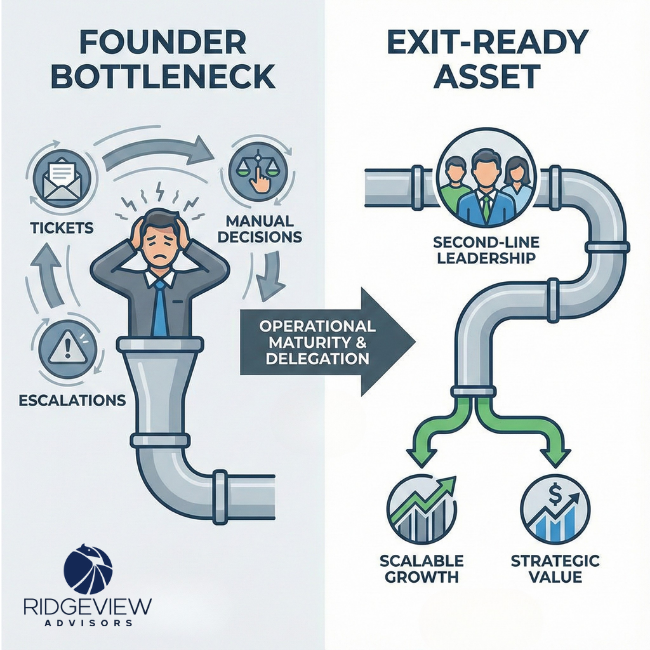
In the early days your technical skill was the engine of growth. As you scale, that same skill becomes a liability. If every high-level decision, client strategy session, and technical fire drill has to pass through your desk, your growth is capped at your personal capacity. No buyer pays a premium for that.
Transition from “doer” to “leader”
The fix is a second line of management. It usually starts with hiring or promoting your first service manager to install a leader who owns the service delivery engine. We typically see this become mandatory between 8 and 12 employees. If you’re spending more than half your day managing tickets or scheduling techs, you’re already behind.
Delegate authority, not just tasks
Building a second line takes more than handing out to-do lists. It takes handing over ownership. Stop giving your team the answers. Ask them how they would solve the problem. That single habit builds the muscle memory of leadership across the whole organization, so decisions stop routing back to you.
Operational maturity: standardize or stall
Buyers look for operational maturity because it signals predictability, and predictability comes from standardized solutions, not bespoke agreements. Many founders fall into the trap of gold-plating, offering one-off services to win a deal. That creates a fulfillment nightmare and quietly erodes gross margin.
Segment contracts and revenue
Segment your client base by total revenue as the first cut for service levels, then run a rigorous gross-margin review by account. A legacy contract muddying the waters, or a handshake deal that goes unmeasured, is a liability. Convert those into standardized service agreements that match what you actually offer today.
Customized, not bespoke
The goal is customization: flexibility within a standardized framework, not bespoke work for every client. And if your sales team is selling what operations can’t consistently deliver, you’re breaking trust internally and externally. That misalignment is one of the fastest ways to kill a valuation.
Run on an accountability rhythm
A business that’s ready for exit operates on a predictable pulse, maintained through accountability and a structured meeting cadence.
Adopt Level 10-style meetings, where issues get Identified, Discussed, and Solved (IDS) before they become client-facing disasters. The discipline that matters here: metrics are owned by the team, not the founder. Your service manager, not you, holds the team accountable to KPIs like kill rate, CSAT, and SLA compliance.
Pair that with a regular 180: what others call a retrospective, we call a 180 because it’s a decisive turn toward better performance. It’s where you look at what actually broke in operations, not what looked good on a slide, and fix the root cause.
Build an asset, not a job
Scaling an MSP is, in the end, an exercise in letting go. When you empower your second line to run the meeting structures and own the accountability loops, you stop being a technician-owner and become an actual CEO. An exit-ready MSP is one where the founder isn’t the primary contact for any client, throughput and gross margin are managed by a leadership team, contracts are standardized and billing is automated, and operational trust is built into every workflow.
You didn’t start your MSP to be its bottleneck. You started it to build an asset. That asset only grows when you build the structure for other people to lead. At Ridgeview Advisors, we teach MSP owners and their emerging leaders how to make that handoff deliberately. If you want a clear-eyed view of what your org should look like on the other side, start with our MSP org chart guide (opens in a new tab), and when you’re ready to build that second line for real, let’s talk (opens in a new tab).