How to MSP© Podcast · Episode 13
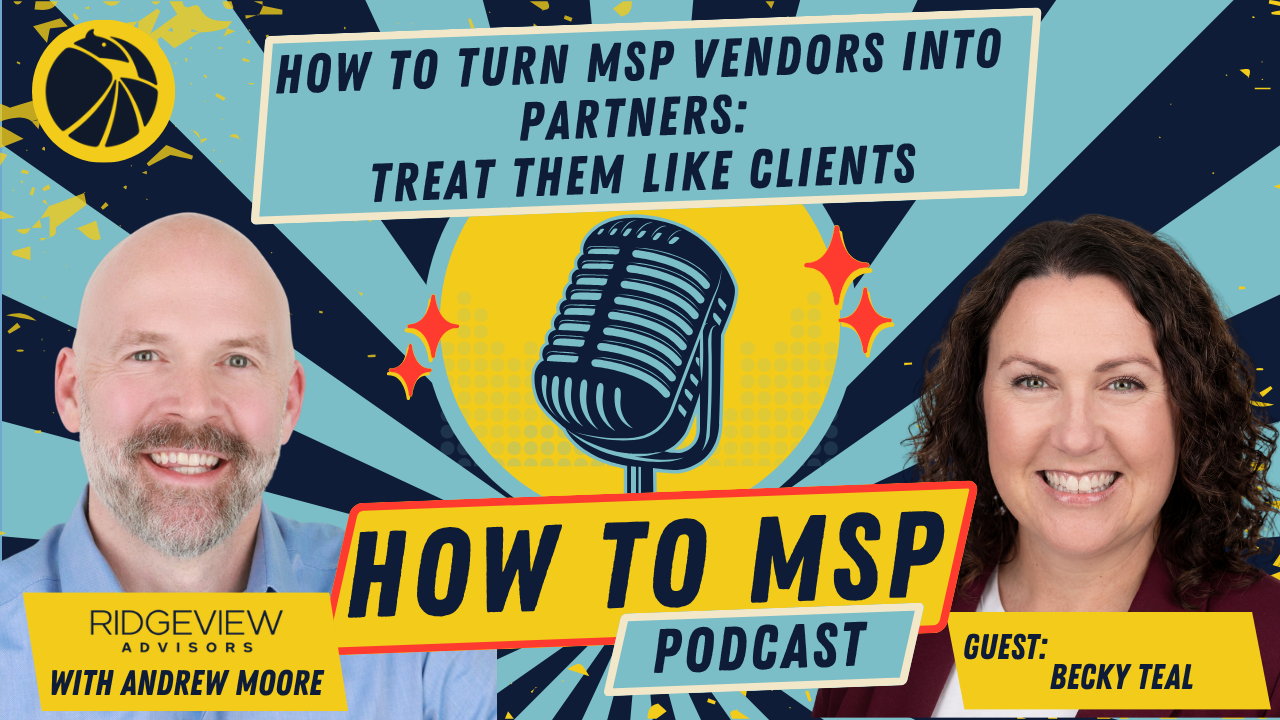
How to Turn MSP Vendors Into Partners: Treat Them Like Clients
Becky Teal of Huntress explains why MSPs lose vendors the same way they lose clients, and what the channel gives away free to the partners who ask for it.
Watch
Listen
Subscribe on How to MSP© Podcast.
Becky Teal watched an MSP tell a vendor it was leaving over two missing features, then watched the vendor answer that the product had shipped both of them years earlier. Nobody had asked. Teal is the Director of Community Peer Groups at Huntress (opens in a new tab), thirteen years in this industry and seven of them at what is now IT Nation Evolve, and she has a blunt read on why that keeps happening.
You know the discipline you expect from your own clients. You want the quarterly business review, or QBR, on the calendar. You want them to tell you what is broken before they go shopping. Now ask how many of your vendors get that treatment from you. On this episode of How to MSP, host Andrew Moore sits down with Teal to work through what the channel actually gives a managed service provider, or MSP, that engages with it. Market development funds, beta seats, incident response tabletops, speakers for your client events. Almost none of it is advertised, and all of it goes to the partners who ask.
MSPs don’t buy product from vendors. They buy product from each other.
- Becky Teal, 1:28
What you’ll take away
- MSPs do not buy from vendors. They buy from each other, and peer group members run a couple of years ahead on adoption.
- Most of what a vendor will do for you is unpublished. MDF, beta seats, co-sell webinars, speakers, and tabletops go to partners who ask.
- Run a real QBR with your vendors using Teal’s four part structure: right, wrong, missing, confused.
- Your first stop on a trade show floor should be the booth of a vendor you already pay.
- Sending only the owner to a conference produces shelfware. Send the service manager who has to live with the tool.
- Give account managers a standing monthly spend they do not have to get approved. The gesture only works while the moment is live.
What is the MSP channel, and why should you care about it?
The channel is the ecosystem of vendors, distributors, peer groups, and MSPs that buy from and sell to one another. You should care about it because it is the only place you get honest, unpaid information about what actually works in a business that looks like yours.
Teal describes the MSP channel as business owners who provide outsourced IT to other business owners, plus the vendors who sell into that group. What surprises people coming from other industries is how freely the information moves. Owners will tell a competitor which tools failed and what they would do differently. Teal has worked in several industries and calls this the most generous one she has seen. The MSPs who show up are the ones who already accepted they do not know everything, which is why Huntress sponsors peer groups heavily.
MSPs and peer groups are a couple years ahead on the technologies they’re adopting.
- Becky Teal, 1:56
Andrew makes the same point from the coaching side. He regularly meets owners who stitched their own security stack on top of Defender when a channel tool already exists. There is a blunter payoff too. One of the most common posts in the peer group boards is an MSP asking for boots on the ground in a market it does not serve.
Why should you treat your MSP vendors like clients?
Because the failure mode is identical. A client who never gets a QBR eventually leaves you over a capability you already had, and that is exactly how MSPs leave their vendors.
Teal tells the story of an MSP running a structured feedback session with a long time vendor. The relationship was good. Then the MSP said there were two things the product did not do, another vendor did both, and a switch was coming.
We’ve done those two things for years. You never asked for it.
- Becky Teal, 17:00
Her explanation is not that vendors go quiet. They communicate through channels nobody reads. Release notes, feature emails, dashboard banners. Teal still fields booth questions asking when a feature is coming to the Huntress ITDR product, meaning identity threat detection and response, months after it shipped. The partner had not logged into the dashboard.
A whole lot of MSPs don’t treat their vendors like they do their own customers. Where they don’t do QBRs, they don’t do regular check-ins. And as a vendor, as a partner in your business, we want that with you.
- Becky Teal, 18:18
Andrew flips it back at the audience, because most owners have lived the other side. You lose a client to a competitor who promised better security, and you have had that security in the stack for five years. The client would never take the review where you would have told them. Teal adds the uncomfortable part: there is probably a signed waiver proving you offered it, and it did not matter, because no relationship was carrying the message. She makes the same argument about leaving a vendor over a small per seat difference. When a partner calls Huntress to cancel, the account history usually shows nobody was engaging. Once you are treating vendors as relationships rather than line items, the next move is recruiting them as referral sources.
What are the Four Helpful Lists, and how do you run one with a vendor?
The Four Helpful Lists is a four part feedback structure, right, wrong, missing, and confused, that Teal uses at Huntress and has watched successful MSPs run as the agenda for a vendor QBR. It works because it forces the two conversations nobody has by accident.
- Right. What is working. This earns you goodwill for the rest of the meeting.
- Wrong. What is broken, missing an SLA, or generating tickets. Bring examples.
- Missing. What you believe the product does not do. This is the column that surfaces the feature that shipped last quarter, and the one that gets an item onto a roadmap.
- Confused. What your team does not understand. This is where the free training lives, and most MSPs never fill it in because admitting confusion feels like weakness.
Teal likes the four part version because it refuses the binary. Right and wrong alone turns a vendor review into a scorecard. Missing and confused turn it into a working session, and those two columns are where the money is.
Run it quarterly, thirty minutes, with the person who touches the tool every day. If your vendor does not offer a QBR, ask, because account managers on that side want the meeting and assume you do not.
A 30-minute conversation once a quarter will keep you abreast.
- Becky Teal, 18:44
What do MSP vendors give away that you have to ask for?
More than most owners realize, and none of it is on a price sheet. Every item below was named in this episode.
- Market development funds, or MDF. Co-op marketing dollars for partner campaigns. Huntress built its program because enough partners asked.
- Alpha and beta seats. Teal picks testers from booth conversations, not her inbox. Your techs get early access, you get influence over what ships.
- Unlimited team training. Account managers and sales engineers will join as many calls as you want, including onboarding for your new hires.
- Co-sell webinars. A vendor expert on your webinar, talking to your clients. No MDF, no size requirement.
- Speakers for your events. Virtual or in person, for client facing events you run yourself.
- Incident response plan templates. If you do not have an IR plan, your security vendor probably has one to start from.
- Facilitated tabletop exercises. A tabletop is a walkthrough drill of a security incident. Huntress sales engineers run rounds of Backdoors and Breaches for partner teams, and Teal offers to send the pizza. Huntress also built a board game for Right of Boom so an MSP can run the same drill with its own customers.
- Show specials and pricing conversations. A face to face ask gets a different answer than a call that opens with a threat to leave.
- Conference passes, sometimes a hotel room. Good partners get comped, and you will be fed at these events, so the real cost is often airfare.
- Roadmap access. Ask where the feature a competitor just demoed sits on your vendor’s roadmap.
- Distributor sales engineers. Ingram Micro, TD Synnex, and Pax8 will help architect something like an Azure Virtual Desktop deployment and flag promotions.
As a vendor, we need somebody who will tell us our baby is ugly. We can’t have testers that just tell us that everything is great. I need really critical testers.
- Becky Teal, 19:18
Teal keeps a short list of partners she can call for critical feedback, and every name came from a booth conversation. Andrew puts the rule plainly: do not ask, do not get.
How should an MSP work a trade show?
Start with the vendors you already pay, then go looking. Most MSPs do the opposite and never have the one conversation that would have saved them money.
- Go to the first timers meetup. Several events, IT Nation among them, run an orientation beforehand. Make a conference buddy.
- Hit your existing partners first. Get the what is new conversations done while you still have a voice.
- Find your account manager in person. If something is broken you can walk them to a table and have the laptop open in two minutes. That does not happen over a ticket.
- Plan with the event app. Sponsors are published ahead of time. Pick targets, then walk up and ask what they do. Teal opens with where did you travel in from, not a pitch. If a booth goes straight for the badge scan, you are allowed to walk away.
- Visit a competitor’s booth even when you are happy. You are not shopping. You are collecting a feature to take back to your own vendor.
- Send more than yourself. This is the one Teal pushes hardest.
Attending is one budget question. Sponsoring is a different one, and the same discipline applies to how you sponsor a conference.
That last point is where the money leaks. An owner comes home with a shiny tool, hands it to the service manager, says implement this, and goes back to running the business. If the service manager did not want it, does not understand it, or is simply too busy, the verdict at renewal is that the tool never worked.
If the service manager doesn’t want to implement that tool, doesn’t like it, doesn’t understand it, or frankly is too busy, at the year renewal mark, that tool never worked. It wasn’t the thing that solved my problems, and we are not renewing it.
- Becky Teal, 32:56
The fix is structural. Teal sees more MSPs naming a primary and a backup owner for each tool, so two people are responsible for knowing it and teaching everyone else. She also recommends sending operations people to events built for them, and calls out MSP Geek for service manager conversations.
Andrew ties that to a growth pattern he sees in coaching. The MSPs that clear four to six million dollars are the ones where operations leadership goes to shows, understands pricing models and escalation paths, and can operationalize what the owner brings back. When only the owner attends, the business tends to stall in the five to ten million dollar range. That is the same wall behind the question of when to hire your first service manager.
Teal also offers a fast test for whether a vendor is genuinely channel friendly. Ask your peers first, because every vendor claims the best support you have ever seen, then look at whether real training exists for your team rather than a manual you read alone.
What is surprise and delight, and how do you use it in your MSP?
Surprise and delight is the Huntress community team’s practice of small, unprompted gestures that show a partner you are watching their business, not only their tickets. It is cheap, fast, and the easiest thing on this list for an MSP to copy. The team follows partner activity on LinkedIn. Business anniversaries get acknowledged. Office moves are Teal’s favorite, and they earn a money tree, which she notes is a sign of good luck and prosperity in a new location.
Your customers know you’re paying attention to them and it really creates that feeling of partnership. It removes some of the transactional barriers. It makes you a bit stickier with them.
- Becky Teal, 38:14
The other direction matters more. When a partner is in the middle of a security incident, Huntress sends food, because the whole team goes hands on and people forget to eat. Much of it arrives without a card. Nobody is chasing credit. The point is that somebody noticed.
Andrew ran the same play from the other side. Breakfast tacos to the accounting firms on April 15 and October 15, because those dates do not move. Halloween candy in a client common area, the good chocolate. Warm cookies to the client who kept paying late, which he says fixed the payment behavior permanently for fifty dollars.
Underneath all of it is empowerment. Andrew gave every account manager a standing monthly budget to spend on clients without approval, and Teal has the same at Huntress. The standing part matters more than the amount.
Not everybody’s gonna spend it every month, but it’s the immediacy. If I have to wait to get budget approval on this thing or go track somebody down to go get approval, the moment is past.
- Becky Teal, 44:57
A card that arrives two weeks late is worse than no card.
Mentioned in this episode
Books:
Music:
Partners and resources:
- Huntress (opens in a new tab)
- IT Nation (opens in a new tab)
- IT Nation Evolve, formerly HTG Peer Groups (opens in a new tab)
- ConnectWise (opens in a new tab)
- Pax8 (opens in a new tab)
- Provarro, formerly Taylor Business Group (opens in a new tab)
- MSP Geek (opens in a new tab)
- Right of Boom (opens in a new tab)
- NinjaOne (opens in a new tab)
- Backdoors and Breaches, from Black Hills Information Security (opens in a new tab)
Also referenced: the Four Helpful Lists feedback structure, Huntress ITDR, Ingram Micro and TD Synnex as distributor resources, Insperity’s loyalty team as a model for client retention, and Tiff’s Treats, the warm cookie delivery service Andrew used on slow-paying clients.
About the guest
Becky Teal is the Director of Community Peer Groups at Huntress, where she helps turn typical vendor and buyer interactions into collaborative partnerships. She is passionate about building healthy channel ecosystems rooted in active listening, genuine connection, and peer to peer learning. Becky is on a mission to redefine how vendors support their partners, operating on the belief that when MSPs succeed together, the entire industry thrives. Connect with Becky on LinkedIn (opens in a new tab).
Chapters & timestamps
- 0:29 Meet Becky Teal: Huntress community and peer groups
- 3:23 What the MSP channel is, and why it shares so freely
- 8:04 Partners versus vendors, and boots on the ground
- 10:39 How to work your first trade show
- 13:54 The partnership benefits MSPs never use
- 15:27 The Four Helpful Lists: right, wrong, missing, confused
- 19:45 Treat vendors the way you want clients to treat you
- 25:22 Choosing a partner: ask your peers first
- 28:58 Empower the people your clients actually call
- 32:00 Send more than the owner, or you buy shelfware
- 34:19 Why operations leadership has to be at the show
- 37:27 Surprise and delight, and how to copy it
- 46:58 MDF and the programs nobody asks about
- 49:37 Training, tabletops, and upskilling for the AI era
- 58:24 The five questions
Transcript
The full transcript is on the page (crawlable for search), collapsed for readability.
Read the full transcript
Becky Teal (0:06): But it's just little acknowledgments that show we're paying attention and we're celebrating your successes and feeling your pain with you. And so I really encourage MSPs to take some of that on as well. Enable your team, especially your account management team, to be following your customer base, paying attention to what they're doing and supporting them in ways beyond just their IT
Andrew Moore (0:29): Hello and welcome to the How to MSP podcast. How are you?
Becky Teal (0:34): I am great. How are you today?
Andrew Moore (0:36): I'm good. This is Becky Teal with Huntress. She is our guest today and she is one of my favorite people on the channel. W why don't you tell everybody a little bit about yourself and why it's important that they listen to what we're gonna talk about today?
Becky Teal (0:52): I don't know how to follow up with being one of your favorite people. I think that says it all. so. I am the director of community peer groups at Huntress. Weird title, but I've been in the industry for 13 years now, which is crazy to think. But I spent the first seven of that at what was HTG peer groups. It's now IT Nation Evolve, so ConnectWise is peer groups. so I have a lot of background in peer group. So this is kind of a natural transition at Huntress. We sponsor a number of peer groups. No, this doesn't mean Huntress is starting our own peer groups. It means that I'm responsible for all the peer groups that we sponsor. What that means though is I'm a firm believer that MSPs don't buy product from vendors. They buy product from each other. They talk to each other, they talk about what they're using, what's making a difference in their businesses. And MSPs who are in peer groups are among the most mature in the industry. They realize they don't know it all and that they can learn a lot from their peers. And so we make a lot of investment in peer groups, knowing that it's where our most mature partners live and it's where we as Huntress learn a ton about what y'all are doing in your business. Because MSPs and peer groups are a couple years ahead on the technologies they're adopting and the things they're implementing in their business than the rest of the industry. So that's my role at Huntress is that part of it. But honestly, it means that I get to spend my time on the road hanging out with a bunch of MSPs that I really respect and learning about their businesses.
Andrew Moore (2:16): Yeah, it's it's the it's really cool because I've r I've coached some MSPs and very early in our relationship, they'll be doing things in their business And I will be like, hey, what why why are you doing that? And they're like, well, I have this spreadsheet and I built this thing and I do this stuff. And I'm like, you know, there's like an MSP-centric tool for that, right? Or they like go out and bake their own security solution. They're like, I picked up this thing and I integrated it with Defender. And then I did this other. And I'm like, hey, y'all, like, there's an entire channel. for MSP that exists where you can show up and there are people like Becky that like are super excited to help you, even if it's not even if Huntress isn't the right fit, they'll just be like, hey, by the way, there's this thing and you should check it out. And like, like we
Becky Teal (3:06): Yeah.
Andrew Moore (3:07): totally help each other. So like I I want everyone who listens to this to understand about the channel, right? Like that it exists and and kind of can you talk a little bit about You know, your history you've talked a little bit about where you started, but like what is the channel and like how do you understand it and like what is the ecosystem like for you as as being a a partner there?
Becky Teal (3:23): Ooh, yeah. So the channel is a weirdly generic term. You know, there's MSP channel, there's VAR channel, there's all sorts of it. I focus primarily on the MSP channel. That's my role in the company. It's my it's where I've lived for a long time. So the MSP channel is this group of phenomenal business owners who provide outsourced IT to other business owners. It's pretty much that simple when you talk about the MSP channel. The folks who really engage in that channel, though, are the ones who are having those conversations. They're going to the conferences, they're in Reddit MSP as much As that can be a weird kind of environment sometimes, but they're reaching out and talking to other people in similar roles, in similar functions in their jobs, and they're learning from each other. And so there's that MSP side of it, and then there's this group of vendors that chooses to interact inside of this channel where they're selling products, services to these MSPs who then resell it to their customers or use it in their own businesses. But The channel is just this beautiful ecosystem of people trying to make each other better. and Of industries I've worked in, the MSP channel is the most absolute generous with their time and their resources. They are willing to tell you things about their businesses, about their worlds, that other industries kind of treat as this weird business secret. and MSPs are just willing to answer those questions and be really honest about what they're doing that's working and what they're doing that's not.
Andrew Moore (4:59): Yeah, I I thought that that was really I've worked in different industries a little bit before I really got into MSP and it was wild to me. Just knowing how freely everyone shared. And sometimes even within their own geographic markets, like other MSPs will be like, hey man, like when especially when they show up to a show, like you'll see people that you like compete against and like on a regular basis as an MSP person, you're like, you're like, that's Acme Corp MSP. Like, I don't like those guys. And then you get to a conference and all of sudden you see each other and you're like, what's up? And then yeah.
Becky Teal (5:32): Hey buddy! I know MSPs who take Ubers to the airport together before shows.
Andrew Moore (5:37): Mm-hmm.
Becky Teal (5:38): one of my favorite things we've done at Huntress, we do a series of roadshows, understanding that there's a good p chunk of the population that doesn't want to travel to events or doesn't want to send their whole team. And so you get them together at these regional events, and these are competitors sitting at these small round tables together. And they first everybody's in their phones, but by lunch, it is loud, they are talking, they are visiting. There's a weird kind of therapy that happens in that environment when you get to talk to other people doing this very weird job that you do as well, that you kind of realize that you're not so alone. So I know a number of MSPs that talk about the friendships they form in these groups that, you know, they're in local business councils, but those tend to also be their customers. So you don't quite get to be as honest about what's going on. That when you go to these MSP conferences, you're with you're with your friends. You're with your actual peers, and you don't get that in your local communities quite as much.
Andrew Moore (6:34): Yeah, that that's a hundred percent. And I think it's funny too, 'cause we'll w when we di get together, we i anybody who's been in MSP long enough knows that there's some horse trading that goes on when when you have clients. Like you kind of swap clients accidentally. just kind of things happen and there you'll be like, yeah, how's how's that that that client working out for you? And there's a little bit like or you'll lose a an employee to somebody else. You're like, yeah, well, or you'll be like, Yeah, I got I got so and so came and worked for me. And they'll be like, Yeah, you know, he was really good on our team or like it it's really interesting like how the wall like you said, the walls kind of come down and everybody just talks a little more openly. And then you kind of at the end of the show everybody gets on the plane and they go home and it's back to competing again and it's back to doing the things you gotta do, right? So
Becky Teal (7:18): Absolutely. That it's a you realize you're all kind of weirdly on the same team. And then you can go back to your separate corners and absolutely compete. But you're right, I know MSPs in their local communities who've even gotten all right, this person needs this specialty, this compliance thing. I'm not gonna add that to my business, so I will refer back and forth with other MSPs or the MSPs who've really set a target size, and if it's below that, they'll refer them to a trusted resource. Like what a cool thing to get to do for your community, instead of just saying, no, I can't take your business, but no, I can't, but here's here's somebody I trust to recommend. So I think there's there's some uniqueness that happens, especially for those MSPs who choose to engage in this channel versus keeping it at arm's length.
Andrew Moore (8:04): And you brought up a good point about just what ven like the vendors and the part we I try not to call them vendors because I think that's shitty. Like I just I like I I do like they're vendors, like they sell things to people and that's what they do, but it's also like and and I I want to get into this with you in a minute about the difference between partners and vendors, but I do like the idea that within the channel, if you are in a peer group or if you are working with a premier partner slash vendor. And you've got like in this day and age, many MSPs are not centrally located to the geographic region that they serve. They'll have clients or their clients will have branch offices in other markets.
Becky Teal (8:45): yeah.
Andrew Moore (8:46): And so being able to reach out to have a partnership ecosystem to be able to say, hey, I've got a thing going on in this in this other market. I wanna be able to have somebody show up and help my client. you can reach out to your your partner, your vendor, you can reach out to other people in your peer groups and you have somebody that you can rely on that you know will do a good job and will represent your firm in a very positive way. And I think that should never be overlooked. Is it not just your you're in the boat together trying to solve problems when you see each other at a show, but you can pick up the phone and be like, dude, I I need somebody to like roll, roll boots on the ground over to this client and help me with this thing.
Becky Teal (9:26): Absolutely, there's certain parts of this role that can't be done remote. There's some things that have to have physical eyes on it. And so it's not uncommon for MSPs to reach out to me to ask if I know somebody in an area. in the peer groups that we sponsor, there's a number of, you know, different communication boards and things that they all interact in. And I think that's one of the most common posts I see is, you know, I need somebody, I need boots on the ground in Bemidji. And so, you know, having somebody that's able to go to those places and go do those things is really valuable because you want it to be somebody you trust that isn't going to actively try and steal that that customer away.
Andrew Moore (10:02): Right, for sure. And like when when MSPs go into the channel and they are, you know, actively like they they get to a certain size or starting to like after they get past the PSA, which is like one of the biggest entry points into the channel, I think. you know, what what w what should they be looking for from partners? Like if they show up for their very first big show, whether that's you know, IT Nation, PAXAid, Datacon. you know, right of boom. There's so many that happen. What do they need to be looking for? Like when they walk the floor for the first time and they're like, my God, look at all the different options I have. Like what do they what
Becky Teal (10:39): Yeah.
Andrew Moore (10:39): it what should they be looking for? Like what do you recommend? How do they engage, you know, in inside the channel?
Becky Teal (10:44): so how should they engage inside the channel? Wow, that First timer feeling at a conference. Like I've been a first timer. It's a little scary. I am not one to just walk into a room with strangers. As personable as I am, I'm strangers and it's not fun. But a lot of the conferences do something pretty unique now where they have a first-timers meetup ahead of time. So there's a bit of an orientation. I know IT Nation ConnectWise's event does this. Definitely engage in that. Make a conference buddy first. It makes it a heck of a lot easier to go walk that show floor if you've got a buddy. so take advantage of things like Like that? Absolutely. Beyond that, my recommendation to newer MSPs or folks coming to their first show is go find the vendors you do business with first. It'll get you used to talking in booth spaces, makes it a little bit more comfortable. You can get some of those what's new in your product conversations done before your voice gives out because it will inevitably give out over the course of hours of yelling in an exhibit hall. And then beyond that, all of these events have apps. You can see who's sponsoring it ahead of time. Definitely target a couple of vendors that you want to go talk to. And just walk up and ask them what they do. we all have a pitch. All of us have an elevator pitch. My standard when somebody walks up and you can kind of tell they're hesitant to walk into the booth, there's always a weird look that happens where they're like, should I walk up to you? Is always, where are you in from? Like, where'd you travel in from? Not gonna immediately ask you if you want to learn about Huntress. We're gonna have a conversation first. Where'd you travel in from? What'd you learn today? You know, something a little bit disarming in a way, but also not right into product. and then we're gonna talk. I'm gonna ask you what your role in the company is because that kind of guides how I'm going to talk about what we do. I'll ask what you know about us. But there's some pretty light questions that should happen. Now, that's not all vendors. All vendors, some of them are going to Immediately want to scan your badge, start asking you questions. The best part of an event, you can walk away. There is nothing holding you in that booth space. If you're in a conversation that you're like, this is not the right fit for me, say, you know what, I'm I'm not feeling this, and you can walk away. you know, that's that's the beauty of these events. but beyond that. Just being willing to engage in that exhibit hall It's a you're gonna learn things. The way I used to coach MSPs when I worked at the peer group was even if you're a hundred percent sold on your current existing solution, you never know when a competitor might have a feature or function that you'd really like to see in yours. So engaging in that conversation, learning what they're doing in their tool doesn't mean you have to switch to their tool. It means you get to go back to your favorite vendor and be like, hey, this other vendor's doing this really cool thing. Where's that on your roadmap? And so there's ways to approach these conversations. It doesn't have to be so adversarial. It doesn't have to be this forced, I know you're trying to sell me something, give me your pitch. Don't go into that mindset, and I think you'll have a much more enjoyable time at the show.
Andrew Moore (13:54): it's it's it's super interesting to me that like once once the the MSPs and the vendors start to interact together, how how little MSPs actually really utilize their partnerships with their vendors, right? Like I like they they show up and to your point, like don't be afraid when you're walking the floor, sometimes you can leave, like, you know, make sure that there's a balance there. You know, find the right partners. However, like once you find one, I've had this conversation with my with my clients a a lot of the times is like one of the most important things that you can do when you go to a show is just go check in with your partners because sometimes they'll go and they'll walk the floor and they're like, well I already know Huntress. I'm like, dude, you need to go see if your account managers at the show. And they're like, why? I'm like, because if you see them face to face, sometimes if there's an issue, they'd be like, that's Tracy. I'm just gonna grab her by the collar and I'm gonna drag her over here and she's gonna get her laptop out and fix that problem for you. Like
Becky Teal (14:49): Mm-hmm.
Andrew Moore (14:50): And and then they don't realize like the benefit of having those direct relationships, but then also like knowing that those direct relationships and engaging in those direct relationships will net them other benefits of the partnership that maybe they didn't even know existed, whether that's MDF or you know, we're doing a roadshow, we'd love to have you out and you meet
Becky Teal (15:07): Uh-huh.
Andrew Moore (15:08): like other people. Like, can you talk a little bit more about like Like what MSP should be doing to take advantage of partnerships in general in the channel and how they should be optimizing things and how partners like to be interacted with with their MSPs, right? Like how does that typically work?
Becky Teal (15:23): man, this is my soapbox. Here we go. I've got a lot of opinions
Andrew Moore (15:27): Let's go.
Becky Teal (15:27): on this one. So very frequently an MSP buys a tool at a point in time from a vendor, a partner, but they buy a solution, they buy a tool, because that's what they need in their business today. How often are MSPs checking back in for updates or even other elements of the product that were there when they bought it, but they didn't need it that day? And so as an MSP grows their business and has other need for other functionality, they're out. Looking
Andrew Moore (15:57): Show.
Becky Teal (15:57): for new tools to solve a problem that it's very often their current vendor solution has or has it on their roadmap. So we used to do a tool, it's one of my favorite things. We use it internally at Huntress now too. It's called the Four Helpful Lists. So right, wrong, missing, and confused. Instead of just calling it black and white, I like the four elements together. And some of the most successful MSPs that I know run that during QBRs with vendors, with their partners. Because again, you bought that tool. At a point in time in your business, you didn't know that you might need this other functionality when you bought Huntress. So, one of my favorite though, from a MSP years ago who used to do this with one of their vendors, you know, they were sitting down for that four helpful list conversation, and they were like, you know what? Our relationship, we've been partners for years, everything is perfect, but you don't do these two things, and this other vendor does everything you do and these two things. I think I'm gonna have to make a switch. And the vendor went, We've done Those two things for years. You never asked for it. So The end of the day, making sure that vendors we think were communicating with you frequently and often about all of our updates. We send you emails about all of our new features and functions. We send it to your whole team. You guys get hundreds of emails a day, and more than that in tickets. You're not looking at it, and if you are, it's probably not important in the instant that you read it. So we have a whole lot of booth conversations with existing partners who want to know my favorite these days is for our ITDR. product, when are you adding a timeline feature? And it's like, well we added that multiple months ago. And people go, well I haven't been in the dashboard. So going to your point, going into your existing partners' booths, I think that is the first stop that MSP should be making in a show, just to go say what's new. And that's I can tell if somebody's done their homework ahead of time because the new the existing partners will walk up and first say, you know, what so great to be here. You know, thanks for being here. And then it's what's new at Huntress. And so then I get to have the what tools are you using? Did you know about this? and then we get to move into a slight road. map conversation if that's where they want to take it, but I do think that a whole lot of MSPs don't treat their vendors like they do their own customers. Where they don't do QBRs, they don't do regular check-ins. And as a vendor, as a partner in your business, we want that with you. Our account managers want to do QBRs, but you assume you don't need it as an MSP. You're like, I know what you're doing, I know what you're working on. I don't need this conversation. And it's like, you know what? A 30-minute conversation once a quarter will keep you abreast. And that's also so we do a lot of new product, new function build at Huntress. And one of the things I get to help with the product team with is finding alpha and beta testers for new stuff. And your techs love nothing more than to getting to play with new technology. I pick who gets to be in those alphas and betas very frequently from conversations I've had on the road. People who've asked for that. I keep a list of who I know is looking for a new thing. As a vendor, we need somebody who will tell us our baby is ugly. We can't have testers that just tell us that everything is great. I need really critical testers. And I have a short list of people that I know I can reach out to all the time. And those people got formed from conversations in booths. That isn't somebody who emails me regularly. Those are people I know that I know I can call on and will give us critical feedback. but it's just something that I just I don't think enough MSPs treat their vendors as partners.
Andrew Moore (19:45): Well so let me make sure I get this straight. What you're saying is is that MSPs should treat their partners, their vendor partners, like they would expect their clients to treat them, which is to actually like have a conversation if there's something like how many I'm I'm sure that there are many MSPs and folks that are in the MSP space that are listening to this that lost a client and the client was like, Yeah, well you guys just didn't, you know, have any good security tools and you were like, Bro, like we've had like security for five years and and they're like you just wouldn't have an SBR with us and if we did have one you wouldn't talk about what you needed and you know, like w we didn't check in. Like we've sent you emails and like it's so like we need FaceTime with you. Like if if
Becky Teal (20:28): Mm-hmm.
Andrew Moore (20:29): If MSPs aren't doing that at a baseline with their clients, that's a first problem. Secondly, if they are doing that with their clients, there's absolutely no reason why they shouldn't be doing that with their vendors, their partners, right? And here's the dirty secret that I'm gonna tell that like people need to know. If you also want to have a conversation about price with your partners, like if you go to a big show, sometimes they'll run show specials. They're not always going to be able to like change your pricing, but it's always better to show up in person and have a conversation about money and be like, Do you have any specials at the show? Is there anything you can do for me? Versus like looking at it and calling your your partner and being like, You're too expensive and I'm gonna move to SoFos. And you're like, wait, what? And it's like, Yep. Like I I just unless you can make something happen on the money, like That's not a partnership, right? That's just straight price line negotiation and I don't I don't think that that's the that doesn't get you, I think, to become a world class MSP even if it does pick you up a little bit of of margin in my opinion. Like it's just
Becky Teal (21:30): But if you're switching tools based on price like that, I think you're missing some of that relationship equity. and there's also the cost of switching that I really think a lot of MSPs don't always think through. you know, a couple a couple of cents saved on a tool doesn't necessarily there's always that grass is greener kind of mentality. yes, we've had partners call us and say they're leaving and when we look at the account and we look at the history there wasn't an engagement there. There was something missing. But to your point about MSPs who are shocked when a customer leaves them for security, I would venture to bet there's a waiver signed somewhere along the way that says we talked about this and you didn't want it at the time. Somebody else came in the door and convinced your customer that they could keep them more secure than you can. And they went, shoot, I don't feel secure. And didn't bother to check in with you because there wasn't a there wasn't a relationship there. So yes, I I you hit it, you know, treat your vendor partners as you would expect your custom like as you want your customer relationships to look like. And yeah.
Andrew Moore (22:39): Well, I would just say there's like a majority of MSPs in this space are selling into the SMB component of of our economy. And so, you know, people are buying IT services and solutions from folks that they know, that they trust, that they feel comfortable with, you know, obviously there's a pricing component that comes with it. But I think that really bubbles up into the upper part of the channel and the partnerships that happen with with folks, right? Where I think that the partners in the channel, a lot of them being, you know, rehabilitated MSP operators and owners and sales folks themselves
Becky Teal (23:14): Yes.
Andrew Moore (23:15): get the relationship. And so I think they really crave the ones that are successful, crave the opportunity to be able to interact and and work with their MSP customers because they really understand how important it is to build trust because ultimately, you know, we have to as MSP owners and operators, we I say we am not an MSP owner operator anymore. But we had in the in the when I was doing it, our focus was trying to build that trust with the the clients that we were having. And we had to rely on our tools to do certain things, right?
Becky Teal (23:48): Mm-hmm.
Andrew Moore (23:48): And so I think it's very similar to your point when you're working with a partner is I wanna know that when I say that that if the backups say that they're green, the backups need to be green. Because the last thing
Becky Teal (23:59): yes.
Andrew Moore (24:00): I need to do is go to my client and be like, look, I know you're not gonna believe this, but I can show you the report. It showed all the backups were good, but your backup wasn't good and we lost a bunch of data. Like if you're not having regular conversations with your partners to make sure that their product is in line and you can trust them and if and if God forbid something terrible happens, you have a a way of escalating through them and communicating with them at a at a place beyond submitting a ticket. You know, I I think that's I really want to talk about that for just a second. It's just like partner selection and like when you go through this process, you know I hear a lot of the times people are very frustrated that Microsoft kind of pulled out of the channel a while back and now they're pushing things through their Disties and Vars. And you know it you know, PAX8's been doing a pretty good job of trying to pick up that support, but that can be sometimes difficult, whereas used to be a partner you could go directly to Microsoft. If I have a part if I have a problem with something at Huntress or at Ninja or whatever. I personally have invested in a lot of relationships in the channel. I know I could escalate to somebody like you, or you know, God forbid if I had to go all the way up to Paul or somebody over at Ninja or somebody, I could do that. But people don't know where to start, right? Like, what do you tell MSPs? Where do they start on this journey of picking the right partner, understanding the partnership versus vendor thing, how to escalate? Like, what does that look like when you're having those those conversations with MSPs?
Becky Teal (25:22): So to me, the number one place to start in that is your peers. Not asking the vendors, because we all say a lot of the same thing. All of our support is the best thing you've ever seen. All of our account management is the best you'll ever experience. All of our security tools are the best you'll ever use. I think talking to your peers about their experience, validating that first. We spend a lot of resource at Huntress on our community team. I like to think we were kind of one of the first-ish to really implement a community team of this element. I don't sell things at Huntress. Like I sit on the sales team, that's where I report into, but the community team is not responsible for a number at Huntress. We are responsible for the relationships, cultivating new, growing, existing. We are responsible for all of the elements outside of the product of Huntress that make our partners and the entire ecosystem feel. Like they've got a friend in what we do. So finding those vendors who have those reputations, there's a number of them in this space that have recognizable people who invest back in the community, not just in MDF, but in time. There's a reason why a few of us spend as much time on the road as we do, and that we're at almost every show. It's because I know that face-to-face does significantly more. to to grow our relationship. You pointed it out very well that MSPs are selling IT services in their local community. They are doing business in their local community with people they can see, with you know, people they see out in the community around. As vendor partners, the only opportunity we frequently have for that is it shows. So doing business with a face you recognize with a person you trust is really important. And so for MSPs coming in or trying to solve this for the first time, first I would say talk to your peers before you buy a new solution. Find out who's actually doing the things that they say verbally to you that they're doing. I can tell you all day that what I do is the best thing that's ever happened. Talk to people who want, talk to other people who actually know the solution, who know the people behind it, and get that validated first. Second then would be find a couple of resources inside of the organization. Account managers are great. It's a great first stop. The sales rep, the account manager, someone like that. Those folks tend to though get promoted. They move out of your patch. And so you end up with a new one. Engaging with that new person is important as well. But find a few folks that you can call beyond that. Somebody asked me recently, we were interviewing a candidate for a role at Huntress, and I've been at the company six years. we keep a running tally of what number employee we are. And with attrition right now, I'm employee number twelve at Huntress. Like twelve of over eight hundred.
Andrew Moore (28:10): Yes.
Becky Teal (28:12): So I have been here for a very long time, especially in what used to be a startup land. Six years. It's a lifetime. And so somebody asked, what keeps you there? Because that's a really long time at any job. And I had to it kind of took me aback. I'd never had anybody ask me that question. And I was like, I can still solve problems for people. If a partner calls me tomorrow and is unhappy about something, I can solve that. I know that with authority, I can say, you know what, let me go look into it. Let me see what I can do. I'm not gonna commit to solving it on the phone because I have I'm not the one to solve the problem, but I know where to go to get it solved. And I still have that that leeway inside of the company. and what a rare unique thing to get to have at a company of this size.
Andrew Moore (28:58): That's really important for people to consider within their own MSP as well, just that empowerment to the folks that are frontline with your customers and clients, giving them the opportunity to make sure that they can make an impact and a difference on something whatever it might be is to empower them where it may where it matters most because I think that's where people find engagement, especially in the services industry, right? Where we're providing service and support to folks. If your hands are tied and you can't do anything, I mean that Totally sucks, right? Like you're I would love to help you, but that's a totally different department and I don't think I can do anything for ya.
Becky Teal (29:33): It's awful. Yeah. Or having to go back to somebody and say, I tried and I can't. Like that's also awful. so yeah, it's something we try to be really careful about, but I know MSPs have that same thing. You have a that stellar service tech who you know, half your clients absolutely adore. They get promoted. Guess who the clients are still calling? They're still calling that service tech. They will they will eventually like somebody else, but they imprint it on that service tech and that is their person inside of your company and that's who they're going to. I have a handful of those here that will call me first. we were doing a webinar recently and somebody asked who or we were doing a live partner panel and somebody asked one of the panelists, well who's your account manager? And he went, I don't know, I know these people. And he pointed to the community team because he was like, I like them. That's who I'll call if I need something. Your customers are gonna do the same thing, so enabling your team to have that flexibility, try and guide back to the right person to actually solve the problem. But having those folks that somebody trusts is really important.
Andrew Moore (30:38): I feel like that's one of the most important things that you can be doing so that you're in front of folks on a regular basis. Like if you're going to one show a year and you expect to make the relationships all happen, like I would say that it's there's a lot you have to be real busy, but like if you're going to like if you go to Ride of Boom, I that's like in February, you go to IT Nation in like October, November, maybe hit up Hacks Eight like in the middle of the year. Like if you can find shows, I know Ninja's got one coming up in October. Like if you can kind of hit
Becky Teal (31:05): Yeah.
Andrew Moore (31:05): two or three shows a year and see the same faces a couple times buy a couple of rounds for your partners while you're out there and they're gonna get the credit card out too, don't worry. But like be a part of that, like make some memories, go to some of the dinners, like you know, have conversations with MSPs. Like you need to be out there like consistently having these conversations and meeting the community team and interacting with them on more than just a once-a-year basis if you can afford it. I know that travel is expensive and sometimes shows are are expensive, but I'll also say that like if you're a good partner and you've got a great relationship, I know that There are passes that are provided by the partners. They'll be Yeah, we'd love to have you at the show. Like, we've got a couple free passes. You're a great partner. We'd love to have you. So at least you could get, you know, your passes covered. If you're a big ConnectWise partner, I know sometimes they'll pay for a room or two for you. Like you just kind of to and trust me, like you don't have to buy food while you're there. Like most
Becky Teal (31:55): No.
Andrew Moore (31:56): of these conferences, you're gonna get wined and dined. And so I mean it's really just airfare, right? For the most part.
Becky Teal (32:00): Airfare, hotel, like those things are expensive. I would even take it a step further that I think a lot of MSPs miss the mark and that they only send themselves to conferences. Investing in
Andrew Moore (32:12): Yes.
Becky Teal (32:12): the rest of your team is really important too. So it's something I saw pretty early. So part of my role at the peer groups was training up-and-coming vendors how to sell their products to MSPs. That's actually how I met the Huntress team, was because they sponsored our program early in their lifespan and I got to coach them on how to talk and sell their stuff to MSPs. I know. that owners tend to have this bad habit of bringing tools home from shows. And they come home with this shiny object and they hand it to their service manager and they say, I bought
Andrew Moore (32:42): Yes.
Becky Teal (32:43): this thing. It's gonna solve all your problems. Implement it. And the owner goes back to their office on their merry way to run the business. If the service manager doesn't want to implement that tool, doesn't like it, doesn't understand it, or frankly is too busy, at the year renewal mark, that tool never worked. It wasn't the thing that solved my problems, and we are not renewing it. It ends up being, I think, shelfware. Is that what MSPs call it? It ends up being shelfware. So
Andrew Moore (33:06): Yes. I was about to I was about to say shelfware. That's yeah. Absolutely.
Becky Teal (33:11): So it I know as a vendor, it's my job to get beyond just the owner layer and start to make friends, start to find other people inside the business that we should also align with for those QBRs, for you know, those relationships. A lot of MSPs are starting to create committees where one or two people is responsible for a tool. So there's a primary and a backup. So like at a at a company that we might work with, at an MSP, you know, two people are responsible for knowing Huntress. They educate the rest of the team, but rather than having everybody be responsible, kind of isolating those and making sure that you've got some folks responsible for these tool sets, in those cases, I've got to be really in good with that service manager as well. And so we also invest in a lot of service manager peer groups. We invest in shows that they go to. MSP Geek is one of the best out there for those types of conversations. I think a lot of vendors miss that. And a lot of MSPs are only investing in their own. Attendance the attendance these shows where sending some additional people inside your organization also helps grow.
Andrew Moore (34:19): I'm gonna second this in the I'm glad you brought this up. We didn't not actually plan this part of the conversation at all. It's very organic, but the best MSPs that I know typically have some sort of a tandem of of leadership. And you'll have like an owner and then an operator or salesperson and an operator, but like it's the ones where the The finance people, so to speak, like the owners like focused on revenue and margin and some of these other things, and they're taking that information and and providing it down to the operations team, whoever's in charge of operations, if they're not going to shows like this where they're actively talking to vendors, understanding what pricing models look like, key tools and features, knowing how to escalate, like if they don't start figuring out how to operationalize the finance components of an MSP and then working with the vendors in order to move that forward, they're gonna wind up not. not accelerating as quickly. They're gonna, they're gonna Peter principle, they'll get pro overpromoted into a role, they'll top out. There'll be issues with the MSP as you're going from that five to ten million dollar area anyway. So I really like what you said because I think it's really important. The MSPs I start to see that really get it. hit that like four to six million dollar mark and they're starting to like, our operations team needs to start going to these shows. Like we need to start getting people in. Like we need to start having more than just the owner show up because the owner does. He comes back and he's all like, cost per ticket. And then he he's like, I I bought, you know, this thing and it's gonna automate everything. And, you know, I got this new tool and we're gonna start selling it tomorrow in all of our packages. And the operations team's like, I don't I don't even know what he's talking about. Like what what what is this magic? Right.
Becky Teal (35:53): Yeah. Who asked for this? yeah. It's a it's it's a thing that happens still pretty frequently. Yeah, I think there's there's some opportunity to grow that layer of leadership in your business. Every book out there, every peer group out there is saying very similar to that, that like you've got to invest in the team because the owner can only get the business so far. There is also layers of trust that have to go into growing that team. but if you're trying to wear all of the hats in a business, you're not gonna grow it beyond a certain size.
Andrew Moore (36:27): And and you talked about your community team, right? And one of the things that we talked about before we started recording, which I thought was really cool, is that some of the things that you're doing f with your community team, I I am hearing echoes of of other companies that I've seen. I have a my daughter works for Insparity and so they she works in this This group and inspirity on the marketing side. And their real function is to make sure that they're retaining their existing clients and growing that client base and making them happy and engaging them with new, with with the new sales opportunities that are coming in so that your clients are telling your best story for you. And so from your perspective, like tell the team, tell the folks on that are listening like what your community team does and like what not not so much as it's a sales pitch for hunters, but like I want them to hear how that works and how they can maybe apply it to their MSP and what that feels like in the way that they're dealing with their relationships. Because there were some things that you said and I was like MSP should doing that, right? 100%.
Becky Teal (37:27): So it's a thing we call surprise and delight inside of Huntress. Cheesy name, it really started kind of as a how do we document this so we can keep track of what we're doing. But surprise and delight is just a way to let your partners know, your customers know you're watching what they're doing. So it's little things like business anniversaries. We follow your LinkedIns. So if we see you post about a business anniversary, my favorite is office moves. So if you move offices and I happen to see it on LinkedIn, I am sending you a money tree. Money trees are a sign of good luck and prosperity in your new location. So I'm sending you a money tree and It's little ways that your customers, from the MSP's perspective, if you're doing it this way, your customers know you're paying attention to them and it really creates that feeling of partnership. It removes some of the transactional barriers. It makes you a bit stickier with them because there's a they know you're paying attention to more than just their systems and their computers. You're paying attention to their business and the things that matter to them. So we do it again in a number of ways of recognition if an MSP is having a really Bad day and something has happened. There's been a security incident. We're sending food to their offices because in those worst moments your whole team goes hands-on and people forget to eat. So I'm a big believer that a whole lot of things can be at least made a little bit better with pizza, cookies, and carbs in general and coffee, like caffeine, carbs, those types of things really help a team stay on task and keep moving. And so we try and just kind of take care of people in small, unique ways. Very frequently, unfortunately, that comes without any kind of a card or anything. Sometimes you don't even know who sent it. But it's just little acknowledgments that show we're paying attention and we're celebrating your successes and feeling your pain with you. And so I really encourage MSPs to take some of that on as well. Enable your team, especially your account management team, to be following your customer base, paying attention to what they're doing and supporting them in ways beyond just their IT to really drive some Loyalty is a really strong word, but I don't know what else to call it. But just some alignment there to again show that you're a part of their business.
Andrew Moore (39:38): It's funny you use the term loyalty because I think that's what inspirity calls that team. They're the loyalty team, right? So they're just their their job is to is to show, not to instill loyalty backwards, but ensure their loyalty to the clients. Like what are we gonna do to make our clients feel loved and appreciated and thought about so that we're always top of mind? And I I I've always said this is like this is my my unlock. I don't know if they have these everywhere else, but do y'all have TIFFS treats in Florida? Do y'all know what TIFF's treats are?
Becky Teal (40:06): No, what is this? Tell me.
Andrew Moore (40:07): Okay. So Tiff's treats are and they may be uniquely Texas shit. I don't know. I th they're in Houston. A friend of mine told me, and I don't know if this is true, but there was this person. I I don't know if it's a man or a woman. We'll just say it's a woman because that's where all the great ideas come from. And she decided that she w she was in college and she it was one evening it was late and she wanted warm cookies and she lived in a dorm and she couldn't get warm cookies. So She's like, you know, it's finals. I want warm cookies. I want milk. I can't get them. So she's like, how cool would it be to have a place that delivered warm cookies? How could I do that? So then she started to look and she found out there were places like like the local donut shop and the local donut shop like closes at noon. And they don't open again until 5 a.m. So she's if I just started baking cookies at like four in the afternoon, I could like subrent their space from them and I could make cookies and then I could just deliver them in pizza boxes and stuff into just campus. And so it's kind of matured from there. Now I don't know if this is how TIFF started, but this was the concept that I'm aware of. So now what you can do is you can order warm cookies and you can have them delivered with cookies and milk and ice cream to anybody that you want at any time where they're in their delivery area. And it is the best unlock I've ever found. Like I've had really difficult people that like wouldn't pay us on time and stuff. And I would send them a warm box of cookies and I'd be like, hey, listen, I know your job is hard and I just appreciate you getting us your money as soon as you can. And then by the by the next month, I got paid on time every time because I sent some warm cookies. Like the best The best $50 you will ever spend is a dozen warm cookies, is the best.
Becky Teal (41:37): Absolutely. That's so insomnia is in a lot of cities and they do a warm cookie delivery kind of akin to
Andrew Moore (41:44): Mm-hmm.
Becky Teal (41:44): that. So you can do that. I remember I had to so I take my birthday off every year. It's a rule of mine. I take my birthday off. It's my own personal holiday. I had to work my birthday at at TBG. So it was a couple years TBG booked over my birthday. And so one year and the how dare and Dennis knew my birthday. Like, come on, Dennis. So,
Andrew Moore (42:00): How how dare them? How dare them. Yeah, come on.
Becky Teal (42:06): like Dennis and I are personal friends, I'm friends with his kids, like he knew, but
Andrew Moore (42:10): Ha ha ha.
Becky Teal (42:10): They'd booked the conference over my birthday. And so I showed up with boxes of cookies. Like I'd had bought Insomnia cookies. They were individually wrapped. I'd worked it out with the event ahead of time. One of my favorite memories though was a woman walked up and she's like, well, I can't have that. I'm gluten-free. And I was like, I got you. I will always have, if I'm bringing treats, if I'm taking people out to dinners, I always make sure to accommodate for food, preferences, allergies in every way humanly possible. When I'm walking in blind, gluten-free at an event of that size where there's a couple hundred people there, like gluten-free cookies made her day, and five years later she will still find me at shows to say thank you. Like
Andrew Moore (42:48): That's the best.
Becky Teal (42:49): little touches like that to make people feel seen and taken care of are really important. And I think it's a lost art of basic customer service that I think people forget in the day-to-day, and I see it getting worse the more automated we become, that personal touch and customer service will keep you customers every day.
Andrew Moore (43:14): Yeah, I and I you don't have to it doesn't have to always be spur of the moment. Like we had accounting firms and We were like, you know, April fifteenth comes the same time every year. And we would always send them breakfast tacos on April fifteenth and cookies and we'd be like, Thank you for, you know, working hard. Today's gonna be terrible for everybody. So we just, you know, it's the end of the tunnel, right? Or October fifteenth was another one I think is a big deadline for for accounting firms. Like
Becky Teal (43:37): Mm-hmm.
Andrew Moore (43:38): there you can you can kind of plan stuff like that too if it makes it hard. Or back to the thing that we talked about earlier, which just empowerment. Right. I told every one of my account managers or salespeople or somebody that was on my my service manager, I was like, look, every month you can spend, you know, four or five hundred bucks, whatever it was, like whatever we felt we could afford, right? And and they never spent it. But I was like, But you have you can spend that is up to a certain amount of money to just make the client happy. Take them to lunch, like send, you know, we're in Texas, so calachis and breakfast tacos, right? Like, you know, enjoy those or donuts or you know, show like we used to do a thing where sometimes they would show up, my account managers would just Go to Costco and we'd buy like bags and bags and bags and bags of candy and a bunch of like pumpkins, and we would just put like a whole thing full of Halloween candy and a pumpkin and we would show up and just leave it in their you know, their their common area, and we'd be like, Thanks for being a client, and we'd just leave them a bunch. And it was good, it wasn't the crappy candy too. It was like chocolates and stuff. Like it wasn't just yeah, yeah.
Becky Teal (44:34): So it's not the stuff you hand out at your house to the hundreds of kids. It's the good adult chocolate that people will eat.
Andrew Moore (44:40): Yeah, the good stuff. Like,
Becky Teal (44:40): Smart.
Andrew Moore (44:41): don't show up there with like bubblish and stuff. Like you got like y you know, maybe a few dumdums, but mostly like Hershey's and Eminem's and stuff. Like that's the good stuff. Yeah.
Becky Teal (44:49): You need the good stuff. That's but it's those little touches and to your point. Not everybody's gonna spend it every month, but it's the immediacy. If I have to wait to get budget approval on this thing or go track somebody down to go get approval, the moment is past. It's not as relevant anymore. Whereas I get a budget of money every month and I you know our account managers have it as well where I can just do immediate recognition, I can send quickly, to help just keep that moving. And so it's a it's a little thing we do, but it really makes a huge difference and it's that thing that people remember. People will always remember how you made them feel.
Andrew Moore (45:28): Yeah, for sure. And I and I also like not to just beat this horse too much, but you know, the it's not just like the there have been times where we've had clients that were like, Hey, you know, we're gonna have to push a meeting and I'm like, What's going on? And they're like, Well, so and so's mom passed away or so-and-so like had to put their dog down or something terrible, right? And so it's really like that moment where you're just like Okay, like let's all like grab a card and sign it and send it to them or let's send, you know, you know, a box of cookies or something, just be like, hey, thinking about you. Like it it's just if you wait too long and the moment passes, can you know it is? It's like, it's been two weeks and I probably should have sent a plant or something. I ain't sent anything and like take the time, be thoughtful and Again, I come back to like if you start running your business that way and you're thoughtful of those folks, you're gonna be hyper aware of people who are thoughtful to you and how that interaction works on the partner side. And you'll start to notice it in your your partnerships with your vendors and your and your your channel friends, right? Like your peers and the people that you work with, and you'll start to create this ecosystem of people around you. And and that's really where I think the the benefit of being in the channel pays off and where the relationships pay off and where the hidden gems of the partnership that you would never get if you didn't don't ask, don't get is my thing, right? Like if you didn't reach out
Becky Teal (46:48): Absolutely.
Andrew Moore (46:48): to your partner and say, Hey, look, I've got this problem, I've got this thing, you would never know if they have a solution to it. So you in in having the relationship is the first place to start, in my opinion. Starting there.
Becky Teal (46:58): It absolutely is, but you know, you'd also asked earlier about like MDF and some other things. There's also elements of that that I think a whole bunch of folks never ask about. We do have an MDF program. We didn't a couple years ago, but if somebody asked, we would sometimes find ways to make it happen in an unofficial capacity. So there are so many programs that your vendors have that if you're not asking, if you're not inquiring, it doesn't prompt them to add one if they don't have it. Like we got one put through because we were able to show this many people are asking for this. Like we have to do this thing. So it helps your vendors to get something across the finish line for you. But it's also very frequently there's programs out there, there's different things available that you just didn't ask.
Andrew Moore (47:43): Yeah, and and it could be back to like, even if like I I come back to there's there's a lot of different ways to skin a cat when it comes to getting your cost in line as a as an MSP. And, you know, let's just say that for some reason MDF isn't available, right? Because that's one way of getting your cost down. It's like you're able to, you know, spend a little bit less on marketing. However, you know, we talked about shelfware earlier, having those frequent conversations with your partners to have a a a conversation about listen. What is going on with your roadmap? What are guys doing? Where where are we at with the product right now? And you're like, you guys do that? Like I could get rid of two other tools that I'm having to spend a bunch of time and money on, and I could consolidate down and I get that within the same license. Or the deployment is easy and maybe it's just an extra license add-on that I do. And then I just it's two extra boxes because the product's already deployed and it's not a large uplift on cost to do the transition. My relationship is already with you. You guys provide training. Which would be great, on on the product where this other partner doesn't. Like, you know, before we wrap up, you know, I do wanna talk about that a little bit. It's just, you know, when it comes to like the different ways that they can engage, I I wanna reiterate Obviously, there might be some ways that you could generate some cost savings by getting MDF. Again, I don't think that's a huge one, but that's that's one that a lot of people you know don't look at. There's also the ability of being able to have a conversation about price and making sure the price is in line, right? That's another way. But then consolidating tools, getting things in line, you know, working show discounts, having great relationships. But then the other thing is is like, am I using the tool well enough? Like, how do I learn about this? And then other concepts within MSP. Talk to me real quick before we go, like about training and how that works in the channel and what vendors are doing to be better partners when it comes to training on their tools and just general best practices in the MSP space. Like what are you seeing? How is that working?
Becky Teal (49:37): Yeah. so years ago it would be that you bought a tool and you were just expected to take it home, read the instructions, figure it out. Most of your channel vendors, and I think that's you asked earlier, how do people know if it's a channel-friendly vendor? That's a key one. What type of training is available? And not just training that you have to do on your own, but what resources are available to help my team understand this tool? Your account manager, our sales engineers, all of those folks at Huntress will jump on for as many calls as you want to train your team. We will help you come up with onboarding for your new staff members who have to touch this tool, but we will do as many trainings as needed. We'll also jump on and co-sell with you. If you need a Huntress expert to come on to a webinar, and it doesn't matter what size you are, and that doesn't take MDF, we will come on and do webinars with you. We'll provide virtual speakers for as many activities as you want to do. We'll provide in-person speakers if you're doing an event. There's all sorts of resources that we offer to help you also explain the value of security to your customers. It's not a huntress pit, it's talking about security. But there are so many vendors out there who have a resource like that that just goes unutilized. It's not just a huntress thing. Most of your vendors will do this type of motion with you, especially the ones who are truly channel-friendly. Have resources available that MSPs just don't take advantage of. Again, they buy a product at a point in time, and that's what they use it for, and they forget to include their vendors in their growth plan, in their marketing conversations, in their sales conversations. There are so many resources out there that just don't get used.
Andrew Moore (51:21): It's a really good point too, and I forgot to bring that up, and I'm glad you did, is that, you know, even beyond just the selling aspect, there are a lot of vendors like if you've got a a weird opportunity with a potential new account or one of your existing accounts where like, hey, I got this thing, like, you know, let's just hey, I'm all of a sudden like I've I've I'm I've landed this deal and now I gotta be CMMC and I don't understand what that means or whatever. Like you can engage one of your partners already and just be like, Hey, do you Do you know what this means? Like, can you help me walk through this with the client or sell this big deal? Because I, you know, for everything that we as an MSP do that results in us picking up new clients, that benefits our partners because then we consume more licensing and we're, you know, engaged
Becky Teal (52:02): Absolutely.
Andrew Moore (52:03): with them to generate revenue on their side too. So I think it's important to remember that there are people that will help you pre-game some of this stuff. Now it may not be every partner, but there are some that will, you know, certainly like I know Distyes a lot of the time. MSPs don't realize you could reach directly out to Ingram or Tech Data or somebody and just be like, hey, you know, PAX eight, like, I I don't even know how to do this, you know, Azure Virtual Desktop thing. Like, do you have a sales engineer that you and it's free? Like you're a partner. They're yep, no, not a problem. We'll help you design it and you know figure out how you can get implementation. Like sometimes they'll even come back to you and say, Hey, there's this special that like Microsoft is running, or that we're doing that if you deploy this product in a certain time period that we'll get, you know, ramp on it or a discount or some sort. sort of like points back or so there's like so much out there if you're not asking you're not getting like you just need to know.
Becky Teal (52:50): And it doesn't always just have to be product. So one of our sales engineers' favorite things to do is help your team run tabletop exercises internally. That if you're not testing your incident response plan, if you don't have an incident response plan, we have templates for it. But if you're not testing it, our sales engineers love to get on and play rounds of backdoors and breaches with you. It's a highly technical incident response card game, bit dungeons and dragons-ish, but they have an online version. So if you've got remote employees that works really well, heck, we'll send you. Pizza and play alongside, but they'll act as the they'll run the game for you so that everybody can participate. Like, there's all sorts of funky resources out there, and a lot of vendors have stuff like that that their teams want to engage with you in more than just the product. But if you don't have a relationship with it, you're missing opportunity because if I approached you and we didn't have a relationship and I started talking about some card game, you'd be I have no idea what you're talking about. So embracing engaging in that relationship first. means you unlock things that we're all doing, you just don't know it because we're we're not saying it loudly enough and you're not asking.
Andrew Moore (54:00): And and I'll I'll say this before we move on to our questions because we're we're starting to run up on time here. But one of the last things I'll say
Becky Teal (54:05): Yes.
Andrew Moore (54:06): is I really like the idea that Huntress and other partners are moving towards engagement through interactive training and interactive understanding of outcomes because one of the things that we talked about briefly before we we started recording today was just like the prolificness of AI and how it works and everything. And the one thing that I've really been preaching to everybody that I possibly can is at some point there's a lot of basic stuff that's gonna get automated through AI. Like if nothing else, then it's gonna it's gonna automate a lot of very basic things, right? And so a lot of things that people used to take for granted as ways of engaging in a business process at a lower level in order to understand it, right? Like your entry level people will do task level things in order to get an understanding of the of the broader concept, those kind of things are going to start to dry up a little bit. I don't know what's gonna replace them. But the idea of being able to do tabletops, to do training online, to do interactive training, to do upskilling, working with your partners in order to drive that forward, I think is so important because otherwise you don't get that opportunity in workforce 2.0, whatever it's gonna look like post you know AI adoption, right? You really need to start working with your team members to say. You know, we need to train you on why this outcome is important and what we're trying to accomplish here rather than go check this box, do this, because you mentioned it before. It was like, here's your tool, read the manual, you'll figure it out, and you'll implement it in a way that like, you know, works for you. But now it's more like, what are you trying to accomplish with this? What does the outcome need to be? What is your client trying to see? Like there's so much more nuance in the channel than there was 20 years ago. And the training, I think, is the missing piece that has finally been catching up over the last four or five years where people are starting to realize,
Becky Teal (55:53): Mm-hmm.
Andrew Moore (55:54): like there's video content that can be created. There's all this, you know, robust rich text format stuff that can be created. Like there's images and stuff that can be created more cheaply and effectively. I can work with people remotely. Like, I don't know. I think it's super important. It's it's it's some it's a nail, it's a hammer that I've been looking for nails. Been running around kind of yelling at people about it.
Becky Teal (56:14): But you're right, and I mean, selfishly for our internal teams, like we have a bunch of really talented humans that if they had to do the same thing every single day, they'd get really bored. And so being challenged to help you create content for your customers, being challenged to come up with tabletops, things like that, like it it scratches a creative itch for all of us that we don't get to do often enough. So there's a your vendors want to engage with you in that way. And so challenge them. Help let us let us come up with stuff for you and work with you on something a little bit different than our every day-to-day product conversation.
Andrew Moore (56:53): Yeah, and it's and if you've never done a tabletop, they're incredibly fun. and they're also the y after you get past the first like three or four minutes and people get into it, it's a lot of fun. And
Becky Teal (57:03): Mm-hmm.
Andrew Moore (57:04): we used to do a lot when I worked for the government. stuff we did was was terrifying. But but yeah.
Becky Teal (57:09): yeah, no, it's awful. Like we try and do a little bit lighter. Heck, a couple years ago for Right of Boom, we actually developed an entire board game for MSPs to play with their customers. So we have like this
Andrew Moore (57:17): That's right. Yes.
Becky Teal (57:20): board game tabletop scenario that's written at a very basic level for you to play with your customers. And that was, I mean, one of my favorite creative projects we've done so far. I got to help develop it and design it because it was something we're like, all right, we have this four-hour pre-day. What are we gonna do with everybody? And so we we try and come up with some pretty fun fun ways to help you engage. but yeah, a lot of folks just aren't thinking that way. So
Andrew Moore (57:47): Yeah. No, I get ya and I I agree with you a hundred percent. Well, it it's been a pleasure to to get a chance to catch up with you. Like it's funny for all those who don't know, it we talk about other things too, but this is kinda like this is what we we we just talk about what's going on the channel and we just talk about things that people we know and stuff that's going on and what we're seeing and you know, how we can help each other and so it's been it's been I I know you said you were a little nervous before we got on the call and I was like, It's yeah.
Becky Teal (58:12): yeah no, this was way less painful than I thought it'd be. Thanks.
Andrew Moore (58:15): It's just us getting together to bullshit. Like it's the way it is. So Yep,
Becky Teal (58:15): Huh. Like we always do.
Andrew Moore (58:19): yeah, we do. okay, so quick we'll get into the five questions because I know we're running up on time and I know you gotta book
Becky Teal (58:24): Yes.
Andrew Moore (58:24): it. So what's the best book that you ever read in business that you really enjoyed?
Becky Teal (58:28): Ooh, so you sent me the questions ahead of time, so I came a bit prepared. The Go Giver is my absolute favorite business book. first off, it's a super easy read. but my favorite principle in it is that you give more in value than you receive in compensation, which really drives to a lot of what we've talked about today. I think it's an important way to kind of run a business, and so go giver, hands down.
Andrew Moore (58:52): Love that. And I I just interviewed a a gentleman that talked about referral networks and how to really build referral networks. And his whole thing was like, if you feel like you have given enough to your your referral partners and the friends that you're working with and the folks he's like, you probably just need to give a little bit more. It's like you just need to do it all the time. It'll come back to you
Becky Teal (59:11): I like that.
Andrew Moore (59:12): for sure. Okay. What's your favorite curse word? And you don't have to say it if you don't want to, but you can. It's gonna be recorded. Okay.
Becky Teal (59:17): I can say it. so shit is my favorite curse word. I love fuck. Like it's a great word, but sometimes it's a bit too harsh for a situation. Shit's kind of
Andrew Moore (59:27): Yes.
Becky Teal (59:27): a step down, but it fits in almost any scenario.
Andrew Moore (59:30): I I love it. I I like the I like the elegance of it. It's just shit. It's shit. Yeah. It
Becky Teal (59:34): Yeah. Yeah, it's just shit. And it can be really good shit, really bad shit. It's just shit.
Andrew Moore (59:40): Yeah. Is there's an old every time I somebody talks about the word kind of abstractly like that. Have you heard the George Carlin bit that he does about stuff and shit? That's one of my favorite for those who have not heard, he just said, People, people have you have stuff, other people have shit. He's like, This is my stuff, but that's your shit. And
Becky Teal (59:59): Yep.
Andrew Moore (1:00:00): I every time I hear it, I'm like, Yes, that's exactly right. okay, I think I know this one, but I could be surprised. Who is your favorite band and why? You're on a
Becky Teal (1:00:06): Hmm, man, can I have two? Okay,
Andrew Moore (1:00:10): Okay, you can look too.
Becky Teal (1:00:11): so first is social distortion. It's actually how you and I bonded the first time. Social distortion, introduced
Andrew Moore (1:00:15): Yes, yes.
Becky Teal (1:00:17): to it in college. It was with me through a lot of really formative situations in my life, and it is it's my favorite band. Second though goes a bit further back and it's odd and people always laugh. It's Meatloaf. Meatloaf is my other favorite. It's what my parents listened to when I was a kid. In second grade I knew the entire Bad Out of Hell album. Love it. And I got to take my parents to see him on his very last tour. Like, it's a it's a family memory and Meatloaf will always like I will stop to listen to that.
Andrew Moore (1:00:47): That's okay. So like I I'm okay. In all transparency, like anytime Paradise by the Dashboard light comes on, I'm immediately I like I'm like I don't care who's in the car. I'm like everybody needs to just shut up and we're gonna crank this up and we're gonna listen to it really loud. Yeah, yeah.
Becky Teal (1:00:59): And I'm gonna sing I'm gonna sing both parts. It's gonna happen. It's my karaoke song. Like I'm it is my one of my favorite songs in the whole wide world, as wildly inappropriate as it is.
Andrew Moore (1:01:09): it's so good. And Steinman is just a magnificent writer and he just yeah. okay. Okay, okay. Heard.
Becky Teal (1:01:13): my gosh So
Andrew Moore (1:01:18): Yeah, no, and respected. Like I that's a that was a deep cut and I'm I'm there for it. I like that.
Becky Teal (1:01:22): It's the one that people are like, Wha what? I'm like I If you know, you know.
Andrew Moore (1:01:26): It's good. It it's good. and and social distortion is on tour right now, currently. Yeah. What
Becky Teal (1:01:31): I know, I know. They're playing at Red in Denver in September. I think I might have to fly out for it. We'll see.
Andrew Moore (1:01:37): Yeah, they are. they're playing with the Descendants, I believe. The Descendants are opening. At least the one the show in Austin. We went to go see my
Becky Teal (1:01:43): Okay.
Andrew Moore (1:01:44): son and I went to see Bob Dylan last night and they were showing adverts for the bands that were coming to that particular venue and the Social D was one of So
Becky Teal (1:01:53): very cool.
Andrew Moore (1:01:54): Yeah, but I'm excited. I I might go see them. I actually Jack White's playing there and it seems like it's gonna be kind of intimate and I really wanna see him up close, so I I might
Becky Teal (1:02:03): That would be a unique one.
Andrew Moore (1:02:05): Yeah, yeah, it's should be really good. I wanna say I could be wrong about this and we should check our calendars. I might text you about this. It might be the same week as the Ninja One conference in Austin. And if it is, it might be I need to check.
Becky Teal (1:02:18): I might have to come down for that.
Andrew Moore (1:02:20): Cause it's like beginning of October and I wanna say their show is the beginning of October, but I can't remember when. But so we'll need look at it.
Becky Teal (1:02:24): If it overlaps, like I'm flying in a day early to a conference because it's Melissa Etheridge and Winona Judd at Red Rocks with the Colorado
Andrew Moore (1:02:32): Yes.
Becky Teal (1:02:32): Symphony. Like, who can say no to that? So like I'll go
Andrew Moore (1:02:35): That would be no, that would be awesome.
Becky Teal (1:02:37): no, I will travel. I will plan travel around a confront a concert.
Andrew Moore (1:02:41): Yeah, yeah. Well I'll I'll let you know if if that it turns out.
Becky Teal (1:02:44): Please do.
Andrew Moore (1:02:45): Yeah. okay, and worst sales call or general meeting that you've ever had where you were just
Becky Teal (1:02:50): Ooh.
Andrew Moore (1:02:51): like, that was the absolute worst thing that I've ever been a part of.
Becky Teal (1:02:54): I have so many examples. So I despise conflict, so I'll do anything to avoid it. And I step in it sometimes
Andrew Moore (1:02:59): Mm-hmm.
Becky Teal (1:03:00): because of that. But I I did some memory bank thinking. So my first professional job, I got called into a meeting and I almost got fired. I had been hired as a data analyst. If you know me, that is probably the worst career fit you could come up with for me. And so but we had an element where we worked with low-income families, and I was really good at that element of it. So we're a couple parts of this weird business. And so I got called in and the owner of the business is like, Well, here's the deal. You are obviously not doing the job we hired you to do, and we're all pretty disappointed in your performance. But we're spinning out this larger department of this thing you're good at. So here's your new boss. She's taking it over. She's aware of what's going on here. You have six months to turn it around.
Andrew Moore (1:03:48): Okay, so but six months is long time, but still like that's
Becky Teal (1:03:49): I am six months is a really long time. It was a very small company, but I was twenty five and I was Very I was a very bad data analyst. I probably should have gotten fired that day. But instead I got to go work and build this really cool thing to help families get out of poverty. It was a government grant that helped families move out of poverty. It became a passion project of mine. It's something we can talk about over a drink sometime because it's an area
Andrew Moore (1:04:15): Yeah.
Becky Teal (1:04:15): I'm have a lot of knowledge in in a weird way. But I got a chance then to move over, and within three months I got a massive raise, like doubled my pay. I had all these new responsibilities. responsibilities because I'd found the thing I was good at. And so it taught me to always advocate for the things I know I'm good at and don't try and fit into something that I hate doing.
Andrew Moore (1:04:38): I that's really awesome advice. I I think that's some of the best advice that I've heard 'cause I sometimes I'll do a guest lecture for a college class down at U of H and we talk about the working geniuses at Stephen or that Franklin Sioni talks about. And
Becky Teal (1:04:57): Mm-hmm.
Andrew Moore (1:04:58): and really it's like, what are you good at and what do you like to do? Is like the kind of the sweet spot. And so I love that for you 'cause it's
Becky Teal (1:05:04): If you can find the intersection of those two, you're great. But I mean, what a way to meet the new boss you're gonna report to than to be told so you stink. You're awful at this. But we the low income families really like you. The small group of people really are drawn to you, so we're gonna give you a chance. Good luck. And with that I was like I was shaking. yeah, no, I No.
Andrew Moore (1:05:23): I I bet like I could just imagine you're like trembling at the like in that meeting and you're like walk out and just start crying. Like I I couldn't at twenty five I couldn't have I would have lost my mind.
Becky Teal (1:05:33): No, I had to go take a walk around the block. I lived in Cheyenne, Wyoming at the time, so I had to go walk around the block. It's very small blocks, it's a small community. But then I went and I was like, all right, I'm gonna prove them wrong.
Andrew Moore (1:05:44): Nice.
Becky Teal (1:05:45): And so I got to again got to build this really cool thing and had a wonderful seven years with that company and would have stayed there forever if we hadn't had to physically move and I ended up in the MSP space. So, yeah.
Andrew Moore (1:05:56): I definitely want to hear more about that when I see you again. So definitely wanna find out more about how that went went down.
Becky Teal (1:06:01): Yeah.
Andrew Moore (1:06:02): Well, Becky, I appreciate your time. I you've been more than generous with me in every facet of our relationship. You've always, as the go giver, have typically given me more than I've given you. And I appreciate everything that you've done in support of me and the companies that I've worked for in the past. And I just can't thank you enough for being on the show today. Thank you so much for your time.
Frequently asked
- What is the MSP channel?
- The MSP channel is the ecosystem of managed service providers, the vendors who build tools for them, the distributors who resell those tools, and the peer groups and conferences where they all meet. MSPs use it to validate purchasing decisions with peers, find partners in markets they do not serve, and access vendor resources.
- How often should an MSP meet with its vendors?
- Quarterly, for about thirty minutes, using a structured agenda rather than a status call. Bring the person who uses the tool daily, not only the owner. Most vendor account managers want the meeting and assume their MSP partners are not interested.
- What is MDF, and how does an MSP get it?
- MDF stands for market development funds, the co-op marketing dollars a vendor sets aside to help partners generate demand. You get it by asking your account manager. Huntress did not have a formal MDF program until enough partners asked, which is often what gets one approved internally.
- Should I send more than the owner to an MSP conference?
- Yes, and Teal calls this one of the biggest misses in the channel. An owner who attends alone brings home a tool and hands it to a service manager who did not choose it, which is how shelfware happens. MSP Geek is one event Teal recommends for service manager attendees.
- How do I choose a new vendor for my MSP?
- Ask your peers first. Every vendor claims the best support and account management, so peer validation is the only signal that separates them. Then look at what training exists for your team, and find people inside the vendor you can reach beyond your account manager.
- What is a tabletop exercise, and will my vendor run one?
- A tabletop is a discussion based drill where your team walks through a simulated security incident to test the incident response plan. Many security vendors will facilitate one. Huntress sales engineers run rounds of Backdoors and Breaches with partner teams in person and online, at no cost and with no MDF required.